Exterior Cleaning Baynards Green | Pressure Washing Baynards Green
- Residential & Commercial Cleaning Specialists
- 5-Star Rated Service & Customer Care
- Eco-Friendly Cleaning Solutions
- Expert Team Covering Baynards Green
Get a FREE Quote
Exterior Cleaning Baynards Green
The vocabulary used in exterior cleaning quotations is not always explained, and a few definitions make the difference between comparing like with like and simply comparing numbers. Soft washing describes application of a biocidal solution at very low pressure, generally under a hundred pounds per square inch, which is roughly a garden hose with a spray gun on it. It cleans chemically rather than mechanically and is the correct method for anything porous, coated or laid in overlapping courses. Biocide means a product that kills living organisms — algae, lichen, moss, mould — rather than simply removing them. This is the distinction that matters most, because mechanical removal leaves an intact spore population and regrowth begins immediately, while a biocide destroys the population itself. Dwell time is the interval a chemical is left in place to act. Cutting it short is the commonest way a good product produces a poor result, and building it into the schedule is what allows lower pressures to be used everywhere else. Pure water or deionised water has had its dissolved minerals stripped out through an ion exchange resin, so it dries without leaving spotting or film. It is used on glass, panels and high-level surfaces. Pressure and flow are different things. Pressure, measured in bar or pounds per square inch, determines cutting power. Flow, in litres per minute, determines how quickly loosened material is carried away, and it accounts for much of the visible difference between a professional finish and a domestic one. Substrate simply means the material underneath whatever is being cleaned, and identifying it correctly is the single decision from which every other choice on a job follows. Treatment liability is the insurance covering the surface actually being worked on, as distinct from public liability covering third parties. Stewart Exterior Cleaning carries both. Households in Baynards Green searching exterior cleaning near me will find these terms clarify most quotations considerably.
Pressure Washing Baynards Green
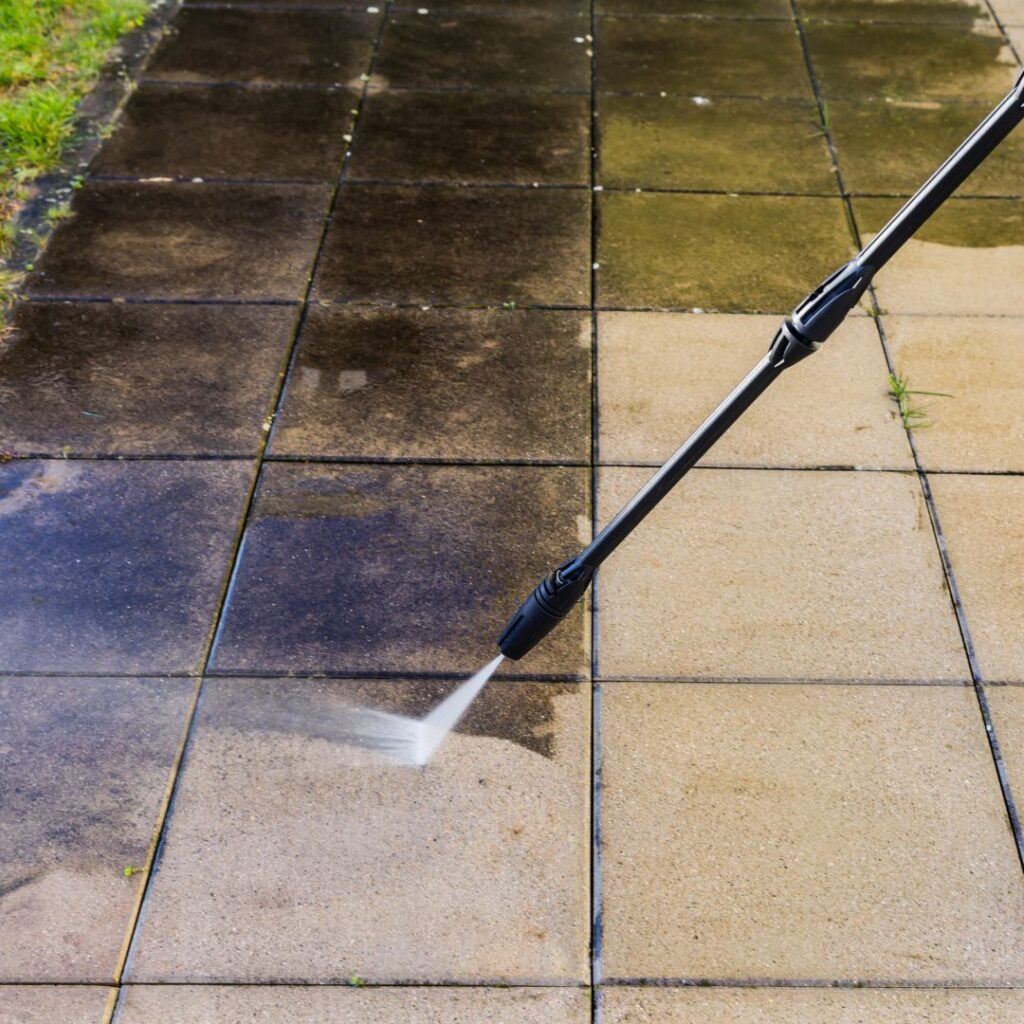
Pressure washing terminology appears in quotations without explanation surprisingly often, and understanding a handful of terms makes the specification legible. Bar and PSI both measure pressure and convert simply: one bar is around fourteen and a half pounds per square inch, so a machine quoted at a hundred and fifty bar is producing roughly two thousand two hundred PSI. Higher is not better in itself, and on most domestic surfaces it is actively worse. Flow rate, quoted in litres per minute, is the number that matters more and is quoted less. Flow carries loosened material off the surface rather than smearing it around, and a machine with high pressure and low flow produces a clean but streaky finish. Professional units typically deliver roughly double what a domestic machine manages. Nozzle degrees describe the fan angle of the spray. Zero degrees is a pencil jet with almost no legitimate domestic use. Twenty-five is the general-purpose choice for hard surfaces, forty is for rinsing and delicate work, and a rotary or turbo head combines a narrow jet with fast circular motion to give cutting power without dwelling in one spot. A flat surface cleaner is the shrouded circular head that sits flat on paving with jets spinning beneath it. Because the shroud fixes the distance from the surface, energy delivery stays constant and the finish is even rather than striped. Hot water systems raise water to sixty or eighty degrees through a diesel-fired coil, dissolving oils and rubber chemically so that far lower pressures achieve the same result. Duty cycle describes how long a machine can run continuously without overheating, which is where domestic and professional units differ most sharply. Pre-treatment is the chemical stage applied before the machine and left to dwell, and it is the reason a well-specified job uses less pressure rather than more. Anyone in Baynards Green comparing pressure washing near me should read the specification for flow and nozzle, not just headline pressure.
Are you based in Baynards Green or the Surrounding Areas?
Patio & Driveway Cleaning Baynards Green
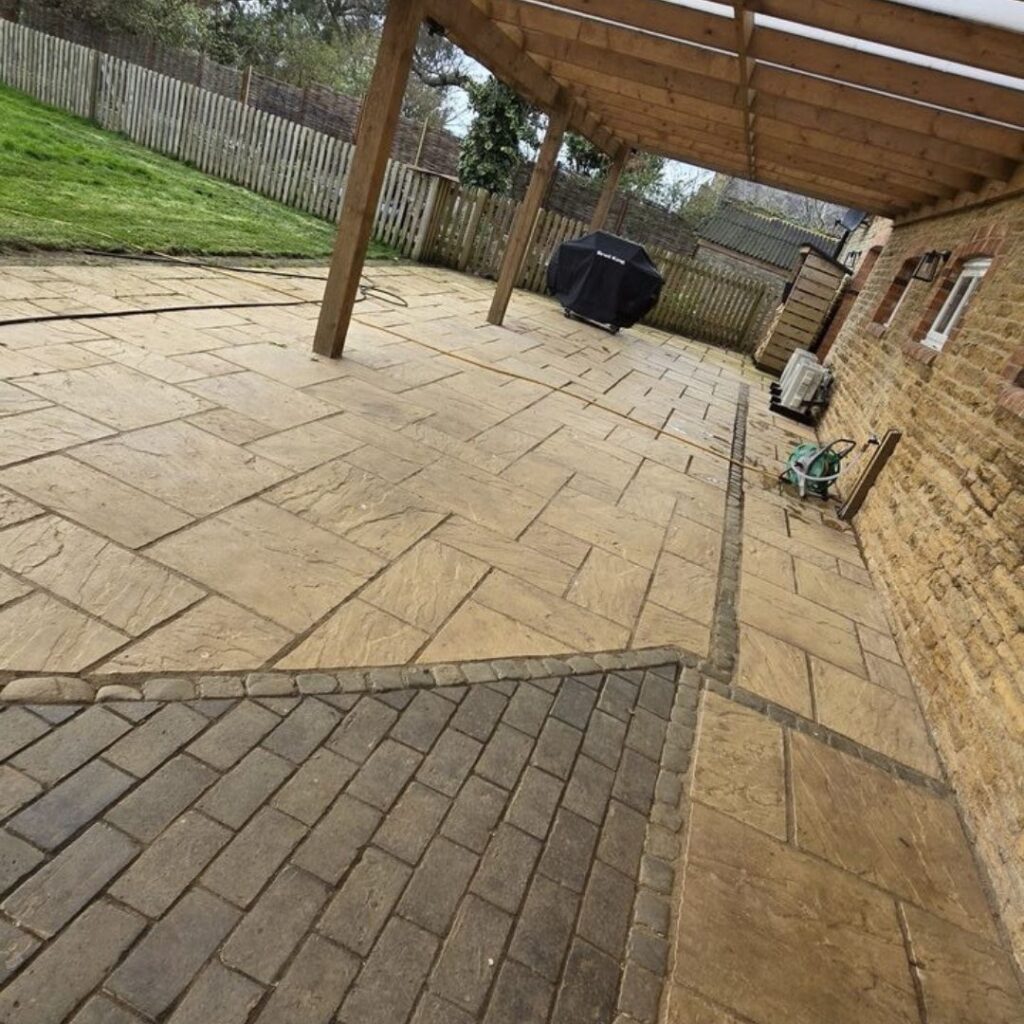
Paving quotations carry their own terminology, and a few of the terms describe the parts of the job that determine whether the result lasts. Interlock is the principle by which block paving works. Load applied to one block is transferred through the jointing sand to its neighbours, so the pavement behaves as a single surface rather than a collection of loose units. Everything about block paving maintenance follows from protecting that. Kiln-dried sand is fine, angular and completely dry, which is why it flows into a joint that ordinary building sand simply bridges. Re-sanding after cleaning is not optional, and it must happen on a thoroughly dry surface, which frequently means a return visit. Laitance is the smooth, dense layer of fine cement paste that rises to the surface of concrete during finishing. It gives new concrete its closed appearance, and once it has weathered away over decades the exposed aggregate beneath is the honest best result any cleaning can produce. Efflorescence is the white bloom of salts carried through a unit by moisture and deposited at the surface as water evaporates. It is not dirt, it usually resolves over a season or two, and it does not respond to biocide. Sub-base is the compacted layer beneath the laying course, and settlement in it is the cause of blocks that rock or areas that pond. Cleaning reveals that; it does not fix it. Poultice describes a paste or absorbent material applied over a hydrocarbon stain to draw contamination back out of the pores, which is the correct approach where pressure would drive it deeper. Edge restraint is the fixed kerb or haunched edging that stops a pavement spreading outward at its perimeter, and once it moves the blocks nearest the edge lose their restraint entirely. Homeowners in Baynards Green booking patio cleaning near me should check that re-sanding appears explicitly in the written specification rather than being assumed.
Roof Cleaning Baynards Green
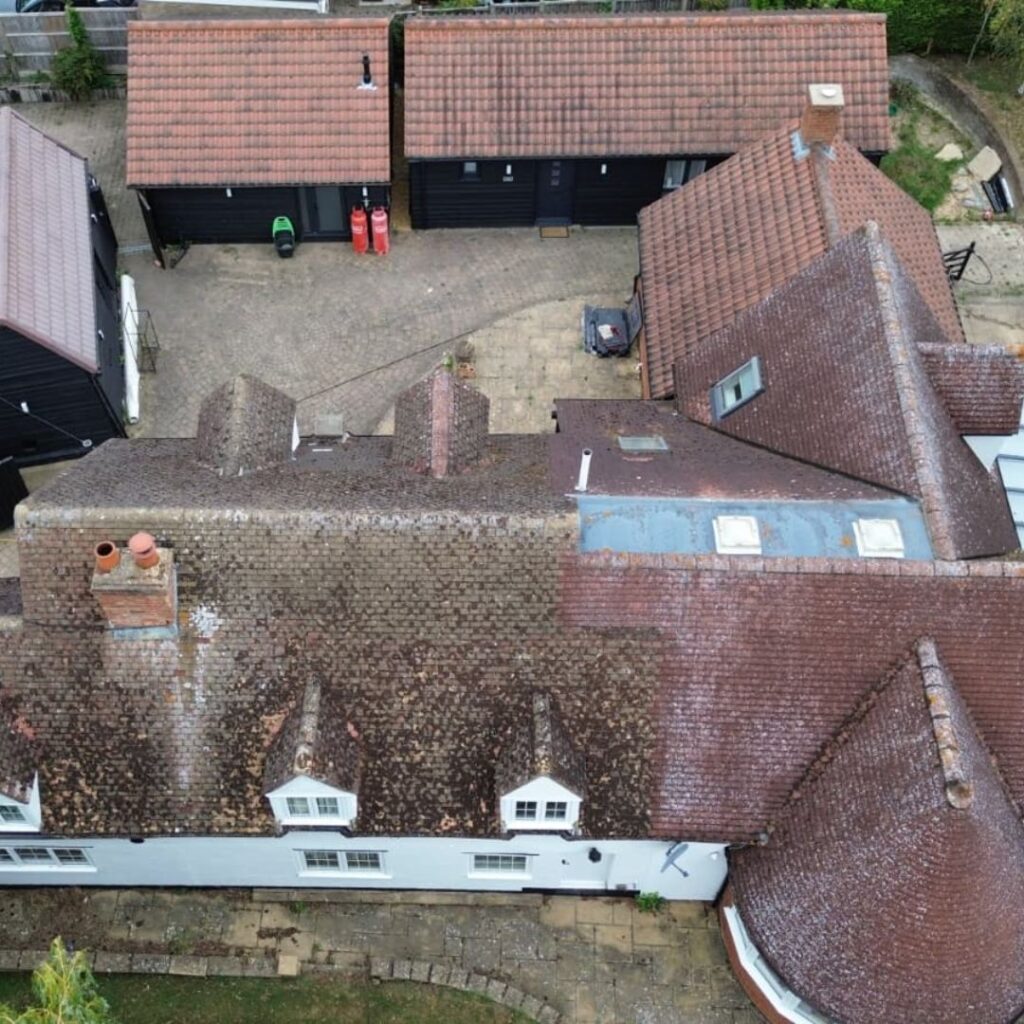
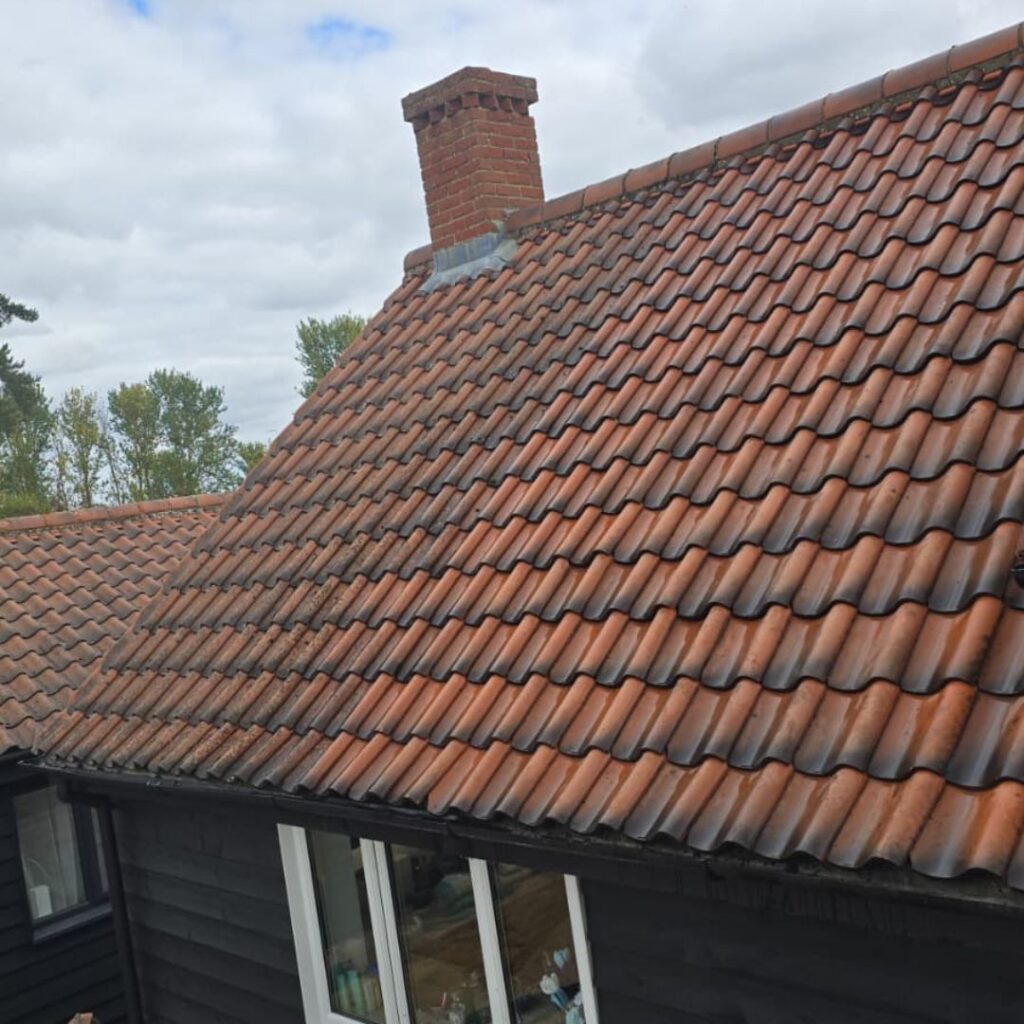
Roof cleaning quotations use terms that describe both the structure and the method, and knowing them makes the specification much easier to judge. The lap is the overlap where one unit covers the one below. It is the single most important word in the whole subject, because that sheltered, damp, undisturbed gap is where growth establishes and where water is drawn in by capillary action once moss holds moisture against it. Capillary action is the movement of water into a narrow gap against gravity. It is how a lap admits water sideways and upward into battens and underlay that were never intended to stay wet. The valley is the internal angle where two roof planes meet, carrying the drainage of both through a narrow channel. Obstruction there forces water across the covering and back under the tiles at the junction, which is a common origin for a leak wrongly blamed on a slipped unit. Ridge bedding is the mortar holding ridge tiles in place, and mortar fillets are the cement seals at abutments. Both deteriorate with age and both are inspected while access is available. Granular surface describes the fine aggregate finish applied to concrete tiles at manufacture. It weathers off over decades, and once gone the exposed concrete is porous and colonises quickly. Pressure washing removes what remains in minutes, which is why it is never used. Soft washing here means low-pressure biocide application left in place to act, with the covering lightening progressively over subsequent weeks rather than on the day. Verge describes the finished edge of a roof at a gable, and open pointing there is a common finding. Flashing is the sheet material, usually lead, weathering a junction between the covering and a wall or chimney. Anyone in Baynards Green searching roof cleaning near me should expect these terms to appear in a written method statement rather than in a bare price on a single line.
Solar Panel Cleaning Baynards Green
Solar cleaning terminology is short but worth knowing, since two of the terms explain why the method is what it is. Total dissolved solids, abbreviated TDS, measures the minerals carried in solution by water and is quoted in parts per million. Mains supply carries a substantial figure, and those minerals remain on glass as the water evaporates, forming spotting and a fine film that scatters light and gives the next layer of dust something to adhere to. Deionisation is the process of removing them, passing water through an ion exchange resin until the TDS meter reads close to zero. Water in that state dries completely clear and is mildly aggressive as a solvent in its own right, which is why no detergent is needed. A string is a group of panels wired in series, and it explains the whole economics of the job. Current through a string is limited by its most obscured cell, so a single bird dropping or a band of moss along a frame edge restricts the entire group rather than just the area it covers. The anti-reflective coating is the treated outer layer on modern panel glass that reduces light lost to reflection. Detergent residue and abrasive contact both compromise it. Microcracking describes the fine fractures caused in cells by point loading, which is what standing on a module produces. It does not show visually and appears later as lost output. The inverter is the unit converting the direct current the panels generate into alternating current for the property, and it is where most monitoring data is read from. In-roof and retrofit describe the two mounting arrangements, the first sitting flush within the covering and the second on rails above it with an air gap beneath. Soiling loss is the generation shortfall attributable to surface contamination, generally somewhere between five and twenty-five per cent. Owners in Baynards Green can measure their own figure with readings taken either side of a visit.

Our Customers Say Everything there is to know about us
EXCELLENTTrustindex verifies that the original source of the review is Google. Fantastic service through out! Our roof looks brand new! Decided to also get the driveway done after seeing the results of first job and what a difference! All for a reasonable price as well. Definitely highly recommend 5*Posted on GoogleTrustindex verifies that the original source of the review is Google. Brendan of Stewart Exterior Cleaning was superb. He obviously knows a lot about looking after the exterior of a property and when he visited to clean our gutters, he clearly explained what was going on and gave excellent advice for the future. He was also friendly and enthusiastic, and gave us the sense he enjoys his work and taking care of his customers. He also mentioned some of his company's other services such as landscape gardening, which probably explains why he has so much expertise. But as it was winter and just before Christmas when he visited, it wasn't the right time for things for the garden, but we'd like to have him back in the spring, so he's probably got a customer for life now! Thanks so much, Brendan – it's very obvious why your business is thriving and we'll be back in touch in the future!Posted on GoogleTrustindex verifies that the original source of the review is Google. Brendan was very helpful and informative, he was quick and efficient in completing the job while answering any questions I had, I would definitely recommend his servicesPosted on GoogleTrustindex verifies that the original source of the review is Google. Returning customer of Stewart Exterior Cleaning. Brendan did a gutter clear for us recently and came back today to carry out a repair caused by high winds. Very friendly servicePosted on GoogleTrustindex verifies that the original source of the review is Google. Great service, roof looks newPosted on GoogleTrustindex verifies that the original source of the review is Google. Great service, couldn’t be happier with the end result. We initially had Brendan in to pressure wash and re-sand our driveway and after seeing the excellent job he did, we decided to have the roof and gutters cleaned as well. The transformation has completely refreshed our home and added fantastic curb appeal. Reliable, friendly, and great value for the service provided thanks again, Brendan!Posted on GoogleTrustindex verifies that the original source of the review is Google. Excellent job completed by Brendan. Was prompt and went above and beyond - given that there wasn’t a useable tap on sight! Also advised what do do after cleaning with regards to paving slabs. Would highly recommend, very excellent price and top notch service. Thank you BrendanPosted on GoogleTrustindex verifies that the original source of the review is Google. Excellent job done in a most friendly and efficient manner. Would highly recommend Brendan and his company to anybody looking to have their gutters cleared and fascia’s cleaned. Well done Stewart Exterior Cleaning.Posted on GoogleTrustindex verifies that the original source of the review is Google. I spotted Brendan working at neighbours property and asked him for a quote to pressure wash my pathway and patio. We agreed a price and the work was carried out a few days later. Brendon is hardworking, friendly and diligent and I’m very happy with the outcome and overall experience.Posted on GoogleTrustindex verifies that the original source of the review is Google. Fantastic service from Stewart Cleaning Ltd. Great work, tidy and very accommodating. Would definitely recommend and will definitely be using these guys again. Thank you! Noticed my dirty windows and even cleaned them despite it not being part of the booked job! Many many thanks.
Gutter Cleaning Baynards Green
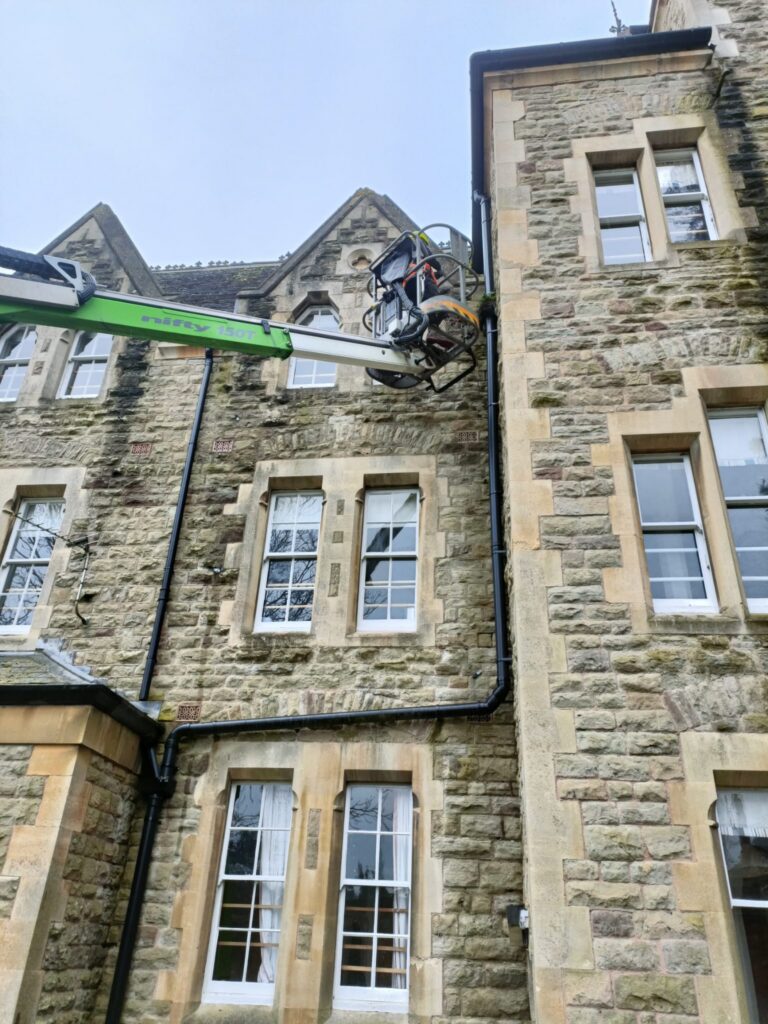
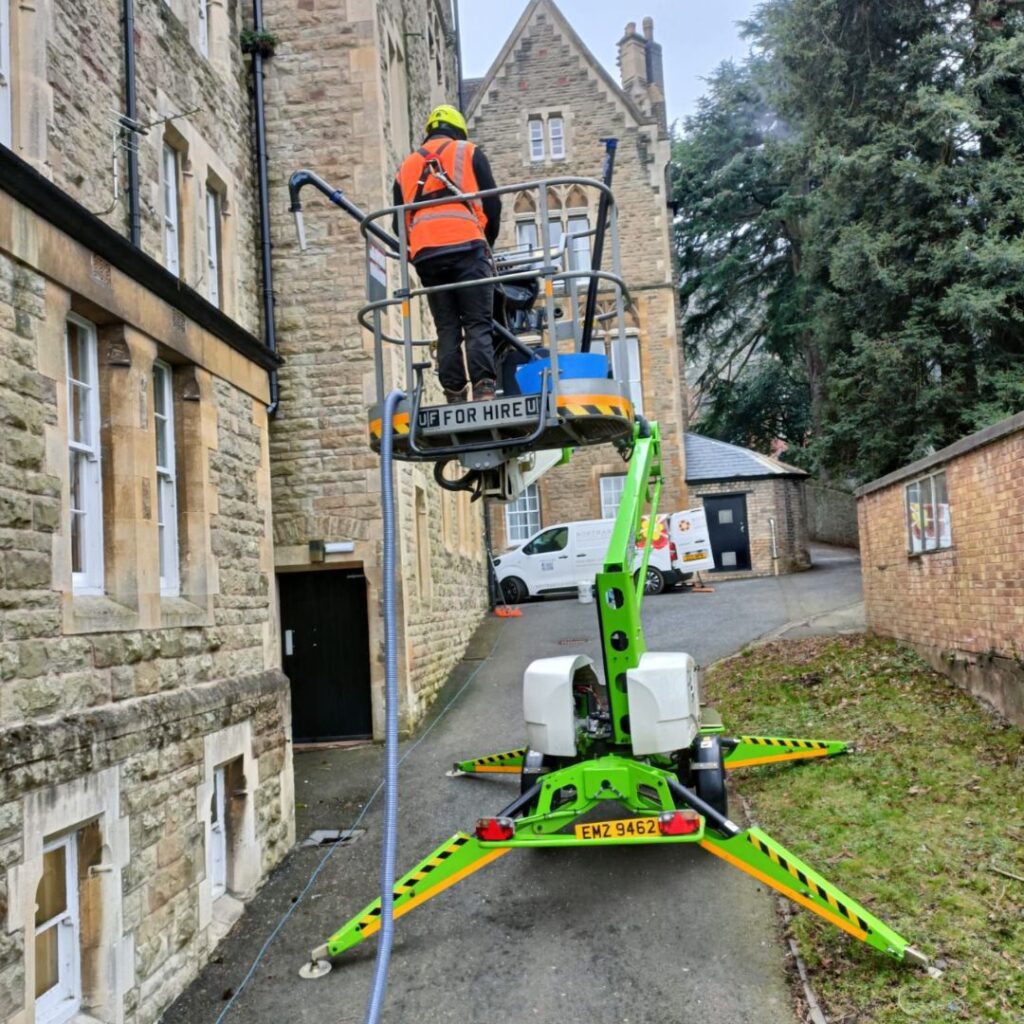
Rainwater goods have a vocabulary of their own, and most of it describes the specific places where systems fail. The fascia is the board along the roof edge that the guttering is fixed to, usually timber even where a uPVC cover has been applied over it. It is where overflowing water does the quiet, invisible damage, because it rots from behind. The soffit is the horizontal underside between fascia and wall, and staining there is a reliable sign of sustained overflow. A hopper is the open funnel found at the head of some downpipes, particularly on older properties, and it collects material at a change of direction where nothing can be seen from below. A swan neck is the offset bend carrying a downpipe back to the wall beneath an overhanging eaves, and it traps debris for the same reason. The gully is the ground-level drain a downpipe discharges into, and it silts up quietly. A clear gutter feeding a blocked gully still fails. Ogee describes the moulded profile of much traditional guttering, as distinct from a half-round section, and the deeper profile holds more compacted material in its base. Fall means the slight slope along a run towards its outlet. Where brackets have loosened or a run has sagged under a heavy deposit, the fall is lost, water stands permanently and the section re-blocks within months regardless of clearance. Union or joint describes the connection between two lengths of guttering, sealed with a rubber gasket on modern systems and with putty or mastic on older cast iron, and it is the first thing to perish. Outlet means the opening in the base of the channel feeding the downpipe. High-reach vacuum describes clearance carried out from ground level through carbon fibre poles into a sealed drum, with a camera at the head allowing the whole run to be inspected properly. Properties in Baynards Green with ogee profiles and mature planting benefit from that inspection most.

Render Cleaning Baynards Green
Render terminology matters more than in most trades, because the name of the system determines the method entirely. Monocouche is a single-coat, through-coloured render applied by machine and scraped back to expose its aggregate. The open texture holds moisture readily and colonises accordingly. Silicone render is a thin-coat system formulated to repel water while remaining breathable, so it stays cleaner longer than most, though sheltered elevations still colonise in time. External wall insulation, often shortened to EWI, describes insulation boards fixed to the masonry and covered with a reinforced base coat and a thin decorative topcoat. The finish is only a few millimetres thick with no rigid substrate behind it, so any impact dents and any breach admits water to a layer that cannot dry. It reveals itself at reveals and eaves, where the wall is thicker than the openings suggest. The base coat is the reinforced layer beneath the finish, usually containing a mesh, and exposing it is what pressure washing does. Carbonation is the gradual neutralising of a cement-based render’s surface alkalinity over its first years. It explains why new render stays clean for a while and then does not. Delamination means the finish separating from what lies beneath, detectable as a hollow note when a wall is tapped, and it must be dealt with before any liquid is applied. Bellcast bead is the profiled trim at the base of a render panel that throws water clear of the wall below, and a blocked or damaged one produces staining that no cleaning will keep away. Scratch coat and float coat describe the successive layers in a traditional two-coat render, as opposed to the single application used in monocouche. Soft washing remains the method across every one of these systems, with the dilution set to the finish rather than applied at one blanket rate. Anyone in Baynards Green comparing render cleaning near me should establish which system they have before comparing prices.