Exterior Cleaning Bucknell | Pressure Washing Bucknell
- Residential & Commercial Cleaning Specialists
- 5-Star Rated Service & Customer Care
- Eco-Friendly Cleaning Solutions
- Expert Team Covering Bucknell
Get a FREE Quote
Exterior Cleaning Bucknell
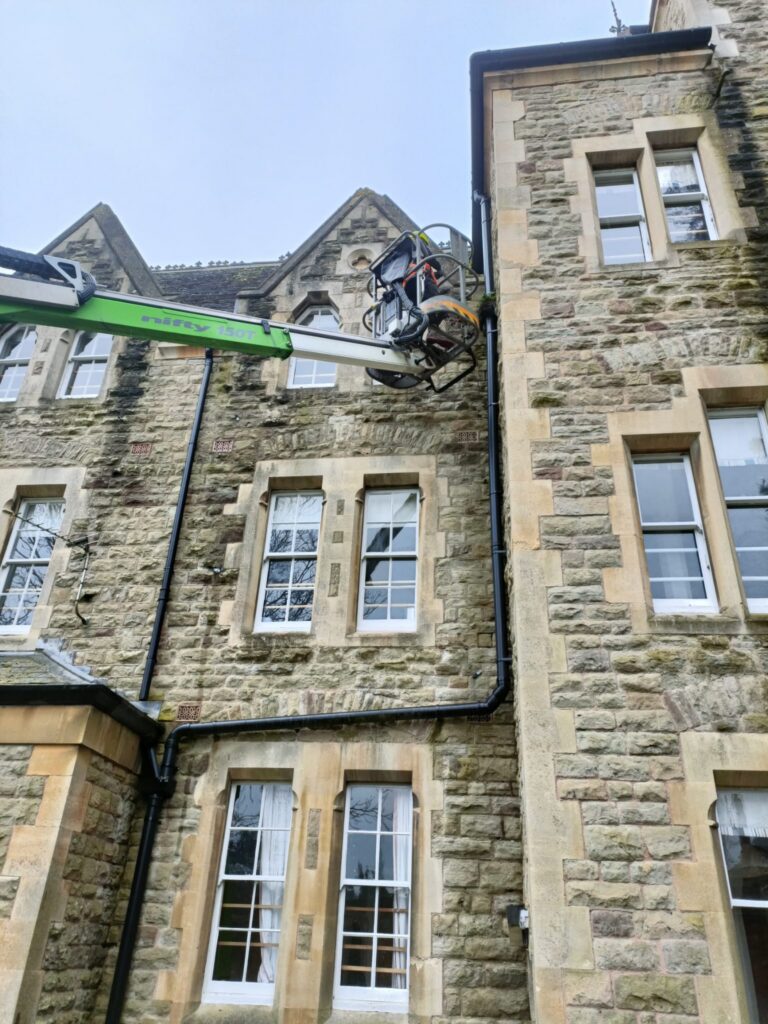
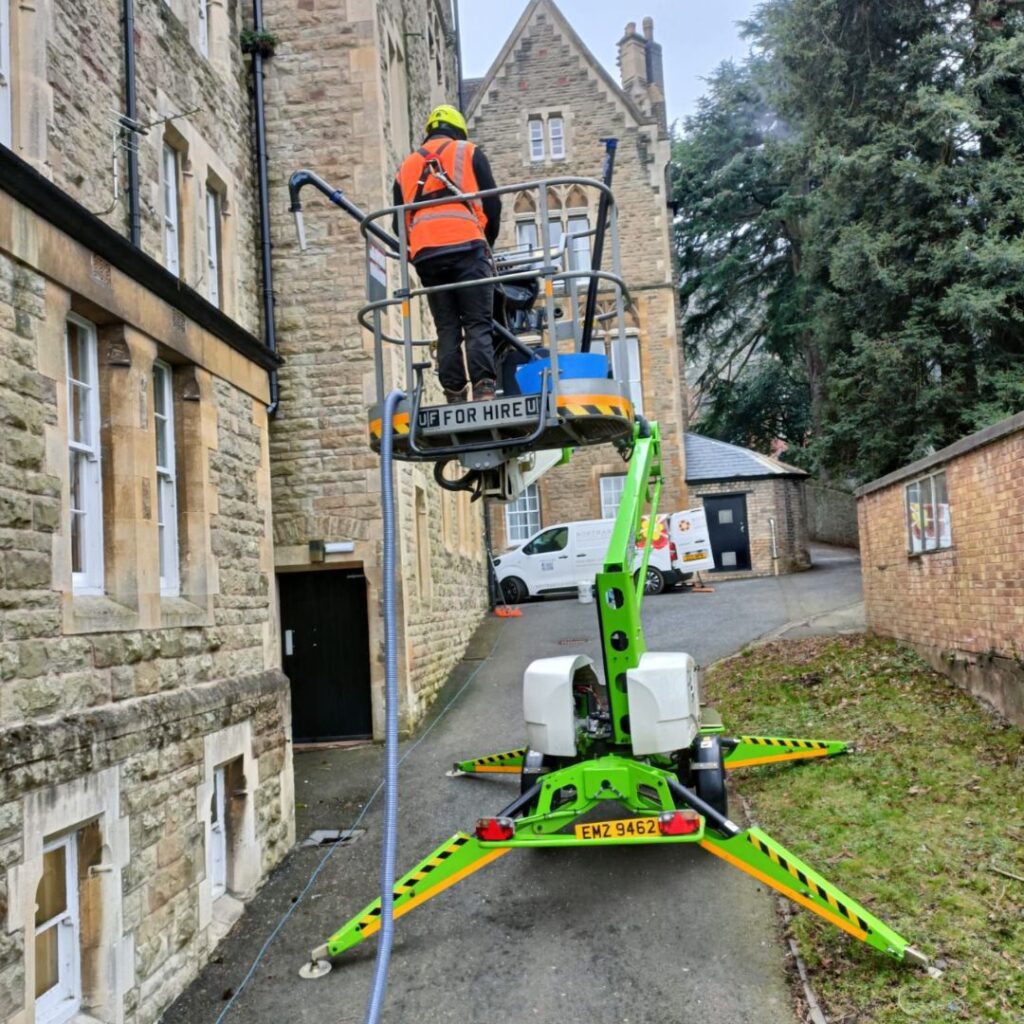
Rural properties present exterior cleaning problems that urban ones do not, and the differences are substantial enough to change both the schedule and the method. Agricultural dust is the first of them. Ploughing, harvest and muck spreading put a great deal of fine soil into the air, and it settles on every horizontal and shallow-pitched surface within a considerable distance. It is not biological, so biocide does nothing for it, and it needs washing off rather than treating. Tree cover is the second and it is the dominant factor on most rural plots. Mature planting shades elevations, restricts airflow, extends drying times after every rainfall and drops leaf litter, blossom and seed continuously. A property surrounded by established trees colonises faster and needs shorter intervals on almost every element. Water supply is the third practical difference. Rural connections frequently cannot sustain the twelve to fifteen litres a minute a professional machine draws, so a buffer tank or bowser becomes part of the arrangement rather than an exception. Drainage is the fourth. Many rural properties are on private systems, soakaways or septic tanks rather than mains foul drainage, which changes entirely where run-off can legitimately go and often means containment and vacuum recovery. Access is the fifth. Unmade drives, soft verges and gateways too narrow for a trolley all affect where equipment can stand. Wildlife and livestock complete the picture, both needing consideration before chemicals go anywhere. What follows from all of it is a shorter interval on nearly every element than the same building would need in a town, and a survey that spends as much time on the surroundings as on the surfaces themselves. Stewart Exterior Cleaning plans around all six of those factors. Households in Bucknell searching exterior cleaning near me should expect the water supply question early.
Pressure Washing Bucknell
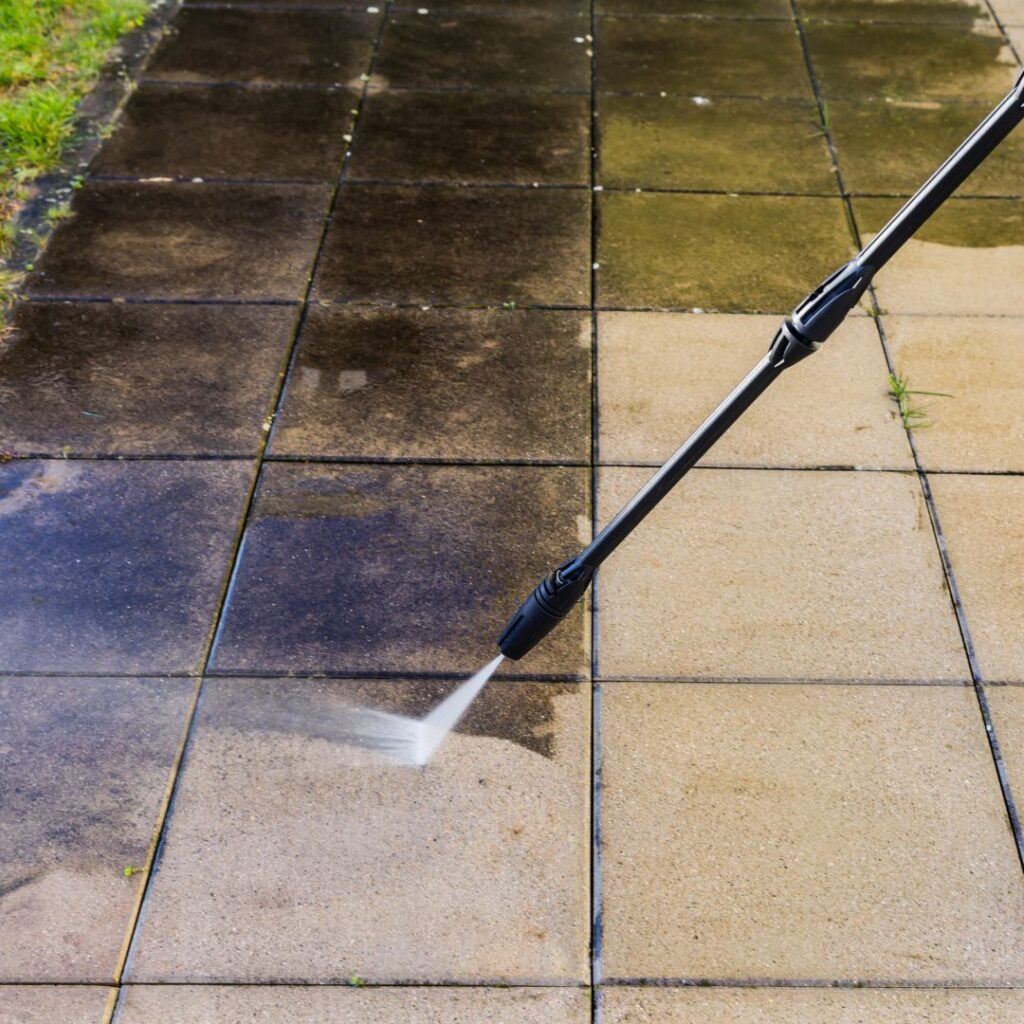
Mechanical cleaning on a rural property runs into practical constraints that rarely arise elsewhere, and they need settling before the day rather than during it. Water is the first and largest. A professional machine consumes twelve to fifteen litres a minute continuously, and a private supply, a borehole or a low-pressure rural mains connection will not sustain that. Running a pump dry damages it, so a buffer tank sits between the supply and the machine to even out the flow, or a bowser is brought. Filling a tank takes time and is factored into the day. Discharge is the second. Where a property drains to a soakaway, a septic tank or a ditch rather than to mains foul drainage, run-off carrying silt, dead organics and cleaning residue cannot simply be allowed to find its own way. Containment mats and vacuum recovery collect it for controlled disposal, and that changes both the method and the time. Power is the third, and it is why petrol equipment earns its place. An outbuilding, a distant hard standing or a yard beyond the reach of any socket is straightforward with an independent unit. Contamination differs too. Rural hard standings carry agricultural mud, silage residue, fuel and hydraulic oil rather than the traffic film of a suburban drive, and heat with a degreasing agent handles those far better than pressure alone. Ground conditions matter for equipment, since soft verges and unmade surfaces will not take a machine on a trolley. Access along the approach is the last consideration and is easily forgotten. An unmade drive, a soft verge or a gateway too narrow for a trolley all determine how close equipment can get to the work, and carrying a machine any distance is both slow and avoidable with a little planning. Anyone in Bucknell booking pressure washing near me should confirm the water arrangement at survey.
Are you based in Bucknell or the Surrounding Areas?
Patio & Driveway Cleaning Bucknell
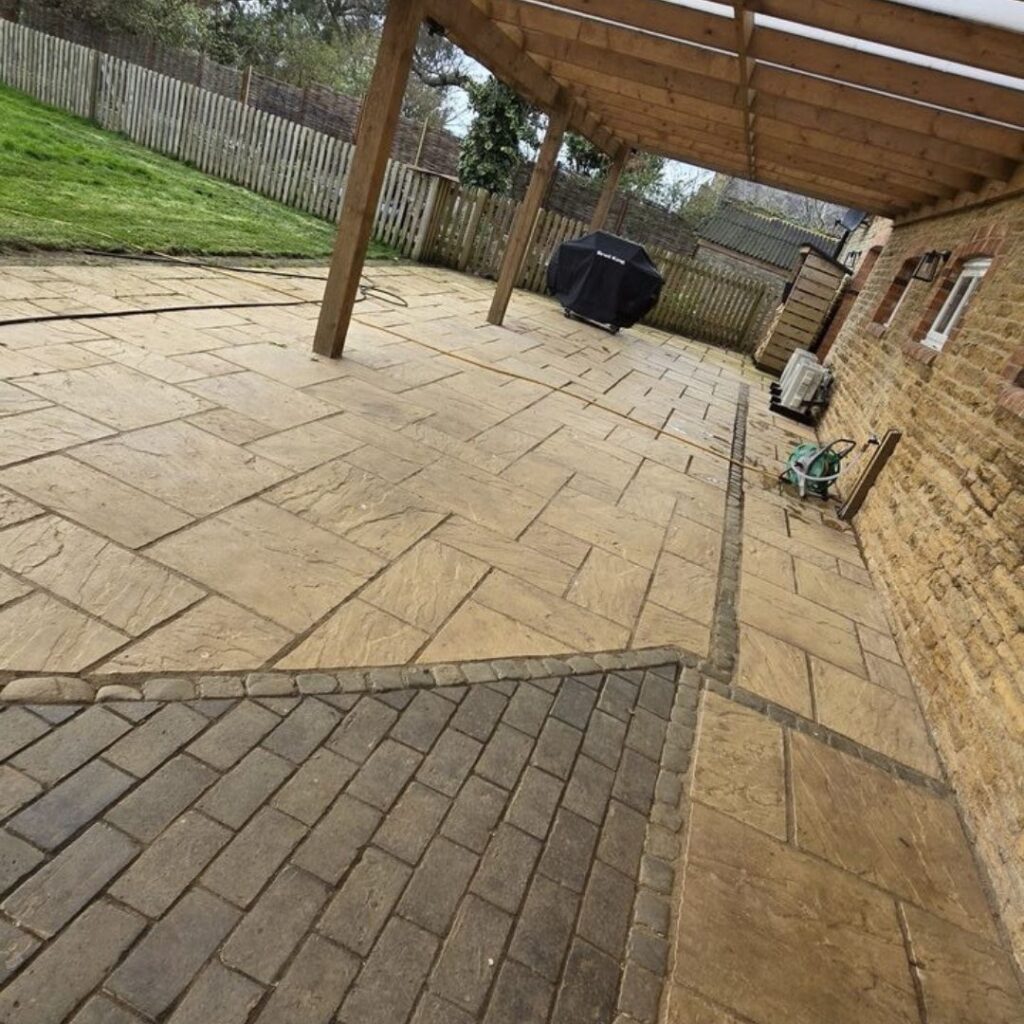
Hard landscaping on a rural property faces conditions that suburban paving does not, and the maintenance interval reflects it. Mud and soil are the constant on any rural approach. Vehicles arriving from fields and unmade lanes deposit far more than the road grit of a suburban drive, and that soil packs into paving joints, holds water and composts down into a genuine growing medium far faster than leaf litter alone would. Extraction of that material is the main mechanical task rather than surface cleaning. Tree cover compounds the problem considerably. Leaf fall, blossom, seed and berry drop in quantity, and tannin staining from decaying leaves is common and needs an alkaline cleaner rather than a biocide. Shade is the third factor and on a rural plot it is usually severe. A drive enclosed by mature hedging or overhanging trees may never dry properly between rainfall, which shortens the cleaning interval to annual where an open surface might manage three years. Agricultural contamination is the fourth. Fuel, hydraulic oil and silage effluent all soak into porous concrete and need emulsifying treatments with dwell time rather than pressure, which drives them deeper. Gravel and unmade sections are the fifth and cannot meaningfully be cleaned. Topping up or replacing is the honest recommendation. Drainage is often to a soakaway or a ditch, which affects where run-off can go and frequently means recovery equipment. And weeds arrive continuously from surrounding ground, so a systemic treatment a fortnight ahead matters more here than anywhere. The upside is that rural hard landscaping is often laid in more forgiving materials, with concrete, natural stone and gravel more common than pattern-imprinted surfaces, which widens the margin for mechanical work considerably. Homeowners in Bucknell booking driveway cleaning near me should expect a shorter interval than an equivalent town property.
Roof Cleaning Bucknell
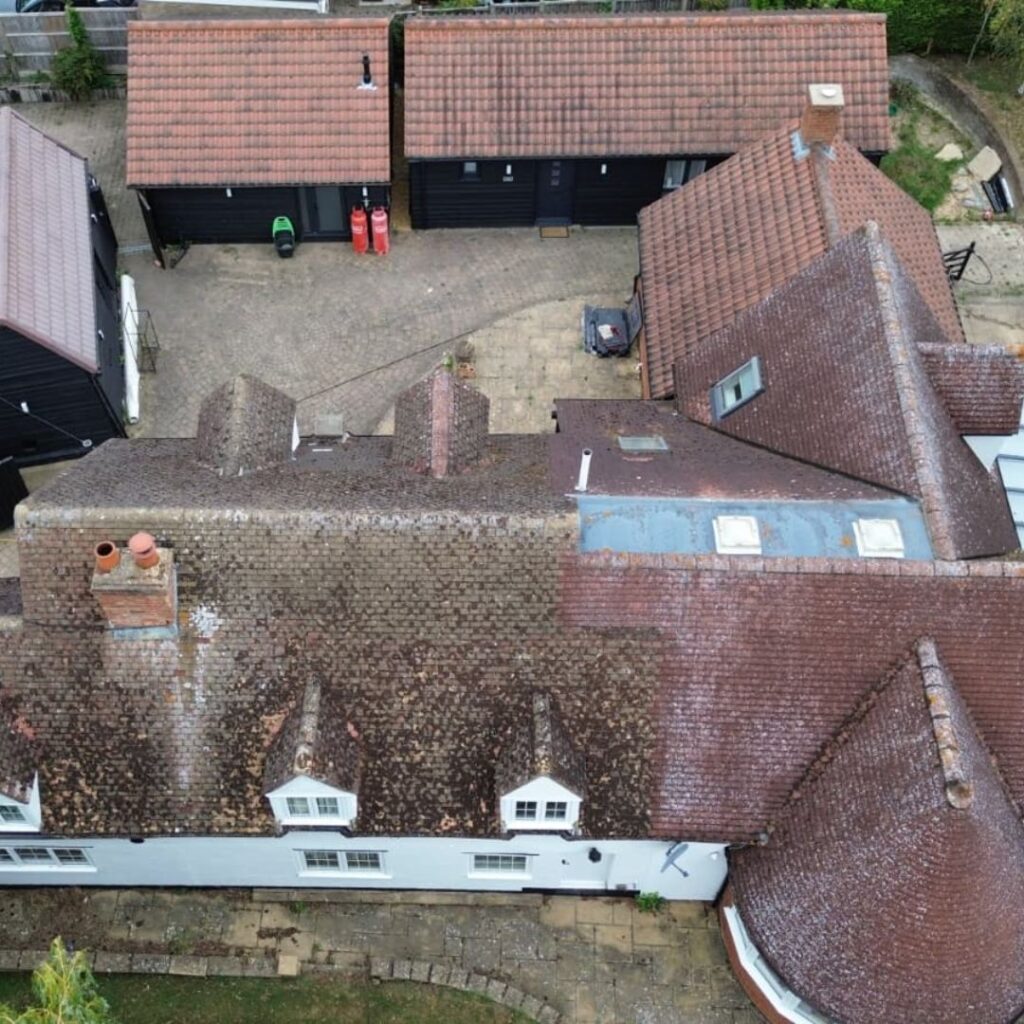
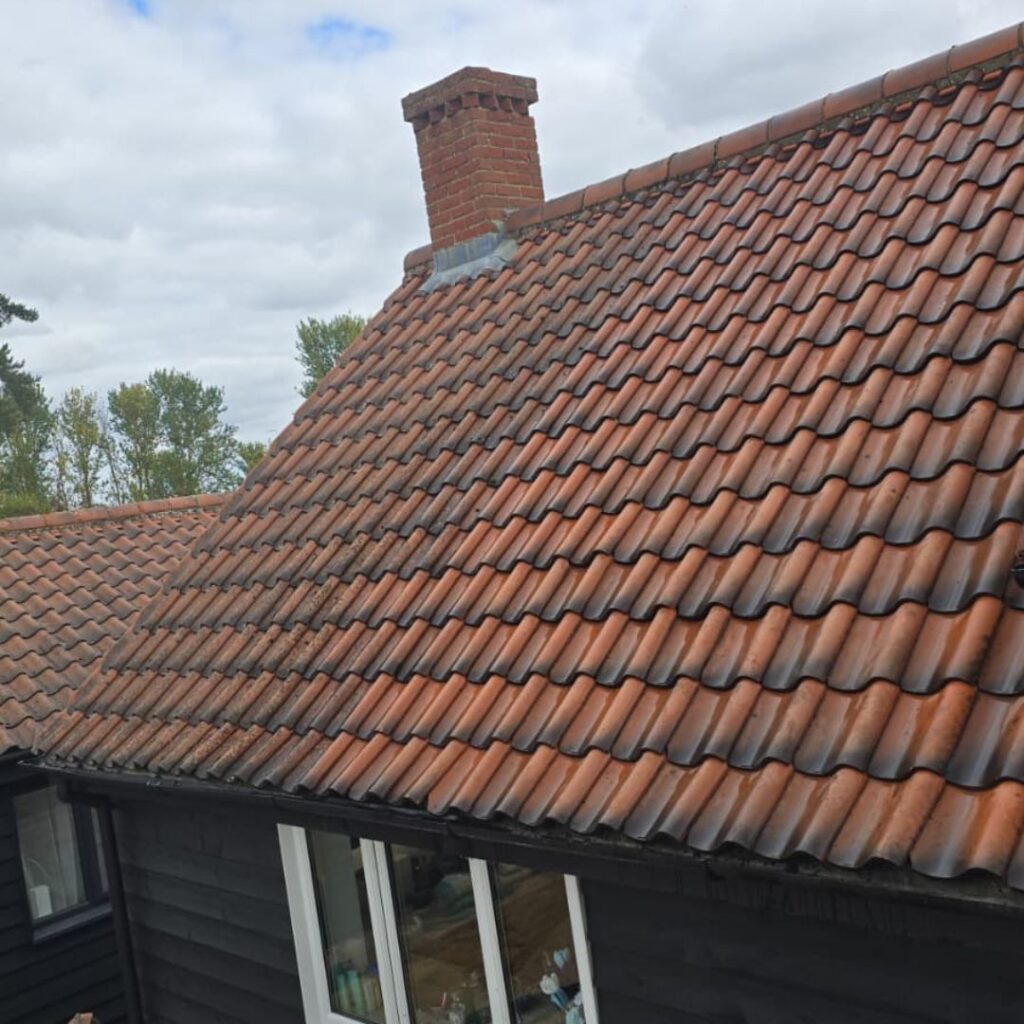
Roof coverings on rural properties carry heavier growth than urban ones, and the reasons are consistent enough to be predictable. Tree cover is the dominant cause by a wide margin. Overhanging branches shade a covering for much of the day, keeping it damp for hours longer after every rainfall, and they drop leaf litter, blossom and seed onto it continuously, which decays in the laps and provides both moisture and nutrient. A plane beneath mature trees will carry several times the growth of an exposed one on the same building. Spore load is the second and follows from the same source. Surrounding woodland, hedgerow and established planting release a great deal more airborne spore than an urban setting does, so recolonisation after treatment is faster and the interval shorter. Agricultural dust settles into the laps and the ridge bedding, providing a fine mineral bed that holds moisture and gives growth something to establish in. Older coverings are more common on rural buildings, and clay plain tiles brittle at the nibs, natural slate held by corroding nails and stone slates all need particular care. On several of them the honest recommendation is minimal intervention and a proper inspection instead. Access is the practical complication. Soft ground, uneven yards, outbuildings tight against a main roof and limited standing positions all constrain whether a tower is usable or whether the work is done entirely from poles. Debris volume is correspondingly greater and all of it has to leave the site. The treatment itself is unchanged: bulk growth removed by hand with soft-bladed tools worked downward from the ridge, gutters and valleys cleared in parallel, and a biocide applied at low pressure and left to act over subsequent weeks. Anyone in Bucknell searching roof cleaning near me should factor tree management into the plan alongside the treatment.
Solar Panel Cleaning Bucknell
Rural solar installations soil rather differently from urban ones, and the pattern is worth understanding properly when setting a schedule. Agricultural dust is the dominant contaminant in most rural settings. Ploughing, harvest and cultivation put fine soil into the air in quantity, and it settles on glass and stays there, particularly on shallow-pitched arrays where rainfall never runs off with enough force to carry it away. An array within reach of worked land can lose noticeably more output than the general figures suggest. Pollen is the second and it is markedly heavier in a rural setting, arriving in a concentrated few weeks in late spring and bonding readily to any existing residue. Bird activity is the third and the most costly. Open countryside, hedgerow and outbuildings all support more birds than a suburban street, and because cells within a panel are wired in series, one obscured cell restricts current through its whole string. Where a retrofit array sits on rails above the covering, the gap beneath frequently harbours nesting, which produces persistent fouling that cleaning alone never resolves. Straw, chaff and general organic debris settle in the frame channels and lodge against the lower edge of each panel, where moss then establishes and grows onto the glass. Water supply remains the practical constraint on any rural site, since deionising equipment still needs a reliable feed to work from, and a buffer tank is often part of the arrangement. Standing ground is the other, with soft yards and uneven surfaces limiting where poles can be worked from safely. The method itself does not change: purified deionised water fed through a carbon fibre pole to a soft brush, agitating lightly and rinsing continuously, with nothing pressurised at the frame seals and nobody standing on a module. Owners in Bucknell frequently justify two visits a year rather than one.

Our Customers Say Everything there is to know about us
EXCELLENTTrustindex verifies that the original source of the review is Google. Fantastic service through out! Our roof looks brand new! Decided to also get the driveway done after seeing the results of first job and what a difference! All for a reasonable price as well. Definitely highly recommend 5*Posted on GoogleTrustindex verifies that the original source of the review is Google. Brendan of Stewart Exterior Cleaning was superb. He obviously knows a lot about looking after the exterior of a property and when he visited to clean our gutters, he clearly explained what was going on and gave excellent advice for the future. He was also friendly and enthusiastic, and gave us the sense he enjoys his work and taking care of his customers. He also mentioned some of his company's other services such as landscape gardening, which probably explains why he has so much expertise. But as it was winter and just before Christmas when he visited, it wasn't the right time for things for the garden, but we'd like to have him back in the spring, so he's probably got a customer for life now! Thanks so much, Brendan – it's very obvious why your business is thriving and we'll be back in touch in the future!Posted on GoogleTrustindex verifies that the original source of the review is Google. Brendan was very helpful and informative, he was quick and efficient in completing the job while answering any questions I had, I would definitely recommend his servicesPosted on GoogleTrustindex verifies that the original source of the review is Google. Returning customer of Stewart Exterior Cleaning. Brendan did a gutter clear for us recently and came back today to carry out a repair caused by high winds. Very friendly servicePosted on GoogleTrustindex verifies that the original source of the review is Google. Great service, roof looks newPosted on GoogleTrustindex verifies that the original source of the review is Google. Great service, couldn’t be happier with the end result. We initially had Brendan in to pressure wash and re-sand our driveway and after seeing the excellent job he did, we decided to have the roof and gutters cleaned as well. The transformation has completely refreshed our home and added fantastic curb appeal. Reliable, friendly, and great value for the service provided thanks again, Brendan!Posted on GoogleTrustindex verifies that the original source of the review is Google. Excellent job completed by Brendan. Was prompt and went above and beyond - given that there wasn’t a useable tap on sight! Also advised what do do after cleaning with regards to paving slabs. Would highly recommend, very excellent price and top notch service. Thank you BrendanPosted on GoogleTrustindex verifies that the original source of the review is Google. Excellent job done in a most friendly and efficient manner. Would highly recommend Brendan and his company to anybody looking to have their gutters cleared and fascia’s cleaned. Well done Stewart Exterior Cleaning.Posted on GoogleTrustindex verifies that the original source of the review is Google. I spotted Brendan working at neighbours property and asked him for a quote to pressure wash my pathway and patio. We agreed a price and the work was carried out a few days later. Brendon is hardworking, friendly and diligent and I’m very happy with the outcome and overall experience.Posted on GoogleTrustindex verifies that the original source of the review is Google. Fantastic service from Stewart Cleaning Ltd. Great work, tidy and very accommodating. Would definitely recommend and will definitely be using these guys again. Thank you! Noticed my dirty windows and even cleaned them despite it not being part of the booked job! Many many thanks.
Gutter Cleaning Bucknell
Guttering on a rural property fills faster and with different material than guttering in a town, and the schedule should reflect that. Tree cover sets the pace. A building with mature trees within falling distance receives leaf litter continuously through autumn, blossom and seed through early summer, and small twig debris all year. Two visits a year is the realistic minimum rather than a premium option. Roof moss is the heavier contributor. Shaded rural coverings carry far more growth, and that growth sheds continuously into the channel where it consolidates with roofing grit and silt into a dense, permanently wet deposit. The spring clearance on such a property routinely produces more material than the autumn one. Nesting is more common. Outbuildings, open countryside and hedgerow support more birds, and nesting material in a gutter or a hopper is a frequent finding. Agricultural dust adds fine silt that fills the voids between the coarser material and helps the whole mass consolidate. Older rainwater goods are more common too. Cast iron with bolted joints sealed with perishing putty needs careful handling, and internal corrosion thins the metal invisibly. Asbestos cement, occasionally found on mid-century outbuildings, is identified, reported and left entirely alone. Access is the practical issue. Soft ground, planted borders tight against walls, outbuildings and yards with uneven surfaces all limit where poles can be stood, and overhead service feeds to outbuildings are an absolute constraint. Discharge often goes to a soakaway or a ditch rather than a mains gully, which is checked and confirmed. The method is the same as anywhere: a high-reach vacuum drawing consolidated material into a sealed drum at ground level, with a camera at the pole head confirming the channel is clear to its base and every downpipe flushed individually. Householders in Bucknell should plan for both visits rather than one.

Render Cleaning Bucknell
Rendered elevations on rural properties colonise faster than urban ones, and the causes are environmental rather than anything about the render itself. Spore load is the first and largest. Surrounding woodland, hedgerow, mature planting and open ground release a great deal more airborne spore than a built-up setting, so every elevation is being reseeded continuously and recolonisation after treatment is quicker. Shelter from the wind is the second factor. Rural buildings are frequently enclosed by hedging, outbuildings, walls and established planting, all of which reduce airflow across the elevations and extend the drying time after every rainfall. An elevation facing a hedge a few feet away may never dry properly at all. Splash-back is the third and is worse where the ground alongside is unmade, since rain hitting soil or gravel throws considerably more moisture and material onto the base of a wall than it does off paving. Agricultural dust is the fourth, settling into the texture of the finish and providing a mineral bed for growth to establish in. Older render systems are more common, and traditional lime render on a solid wall needs particular care: dilute biocide at very low pressure, and never any coating or sealer, since anything impermeable traps moisture in the wall behind it. Water supply and discharge are the practical considerations, as everywhere on a rural site. The treatment itself is unchanged: a biocidal solution at well under a hundred pounds per square inch, left in place to work over subsequent weeks. What helps most between treatments is unglamorous and free: cutting planting back from the base of the walls to improve airflow, and making sure the guttering above discharges properly rather than tracking down the elevation. Anyone in Bucknell comparing render cleaning near me should expect an interval at the shorter end of the usual range.