Exterior Cleaning Hornton | Pressure Washing Hornton
- Residential & Commercial Cleaning Specialists
- 5-Star Rated Service & Customer Care
- Eco-Friendly Cleaning Solutions
- Expert Team Covering Hornton
Get a FREE Quote
Exterior Cleaning Hornton
The strongest argument for exterior cleaning is not appearance but cost avoidance, and the figures make the case without embellishment. Replacing a rotten fascia and soffit run costs several hundred pounds before any decoration. Re-rendering a single elevation runs into thousands. Relaying a settled block driveway costs more than a decade of maintenance visits. Repairing a roof leak that has been quietly saturating battens and underlay is more expensive again, because the covering has to come off to reach it. Every one of those outcomes is preceded, usually by years, by something a cleaning visit would have caught. The mechanism is consistent across materials. Organic growth holds moisture against a surface. Moisture prevents that surface from drying and cycling normally. Trapped water expands in frost, opening joints and microcracks. Water entering those openings reaches material behind that was never intended to get wet. Timber rots, mortar softens, coatings lose adhesion and fixings corrode. None of it happens quickly, which is precisely why it is missed. Regular cleaning interrupts the cycle at the first stage. It also puts a trained eye on parts of the property nobody otherwise looks at closely. Perished sealant, a slipped tile, a cracked hopper, a bulging section of render, a bracket pulling loose — these are noticed during a cleaning visit and reported at a point when they cost very little to fix. There is a resale argument too. Green streaked render, a mossy roof and a stained driveway read as neglect to any prospective buyer or surveyor, and the assumption drawn is that maintenance elsewhere has been equally lax. That assumption is often reflected in the offer. Stewart Exterior Cleaning treats the survey element as seriously as the cleaning itself. Properties around Hornton built from local stone and older materials repay that attention especially well, and exterior cleaning near me searches here frequently begin with a problem that had been developing for several seasons.
Pressure Washing Hornton
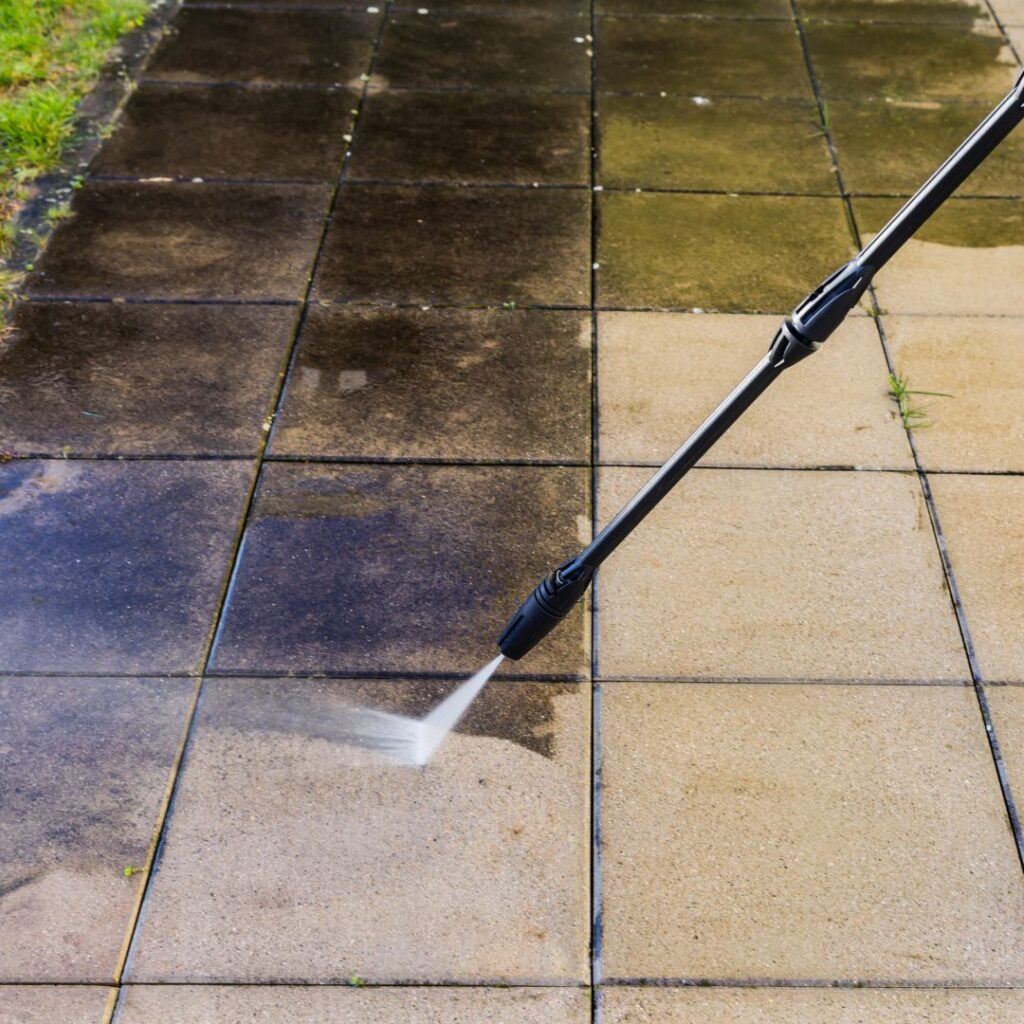
Some surfaces should never meet a pressure washer, and knowing the list is more valuable than owning the machine. Render is first, because force removes the finish along with the growth. Lime mortar is second, being deliberately softer than the masonry around it and easily washed out of the joint. Painted or bare softwood follows, since water at pressure raises the grain and drives moisture into the timber. Roof coverings of every type belong on the list. So do fibre cement, decorative concrete with a pigmented surface, and any elevation where the pointing is already open. That leaves a genuine and useful remit. Concrete hardstanding, engineering brick, natural stone paving, granite setts, dense clay pavers, steel and pre-cast units all take mechanical cleaning well and often need it, since chemistry alone will not shift oil, rubber, ingrained traffic film or the compacted organic matter that fills joints over years. Within that remit, control comes from technique. Working distance is established on a test patch and held consistently. Passes overlap by half their width and run in one direction. A flat surface cleaner replaces free-hand lancing on large open areas, its shrouded rotating head keeping height and speed constant so the finish is even rather than striped. Pre-treatment with an appropriate cleaner, left to dwell, reduces the pressure required considerably. Water management sits alongside all of it. Run-off carries silt, dead organic material and cleaning residue, and it belongs in a foul drain or an interceptor, not a ditch or watercourse. On sites where that is difficult, recovery mats and vacuum systems collect it for controlled disposal. Older stone properties in Hornton frequently need the pressure washer kept firmly away from the walls while it does perfectly good work on the hard landscaping. Anyone searching pressure washing near me should expect a contractor to draw that line unprompted.
Are you based in Hornton or the Surrounding Areas?
Patio & Driveway Cleaning Hornton
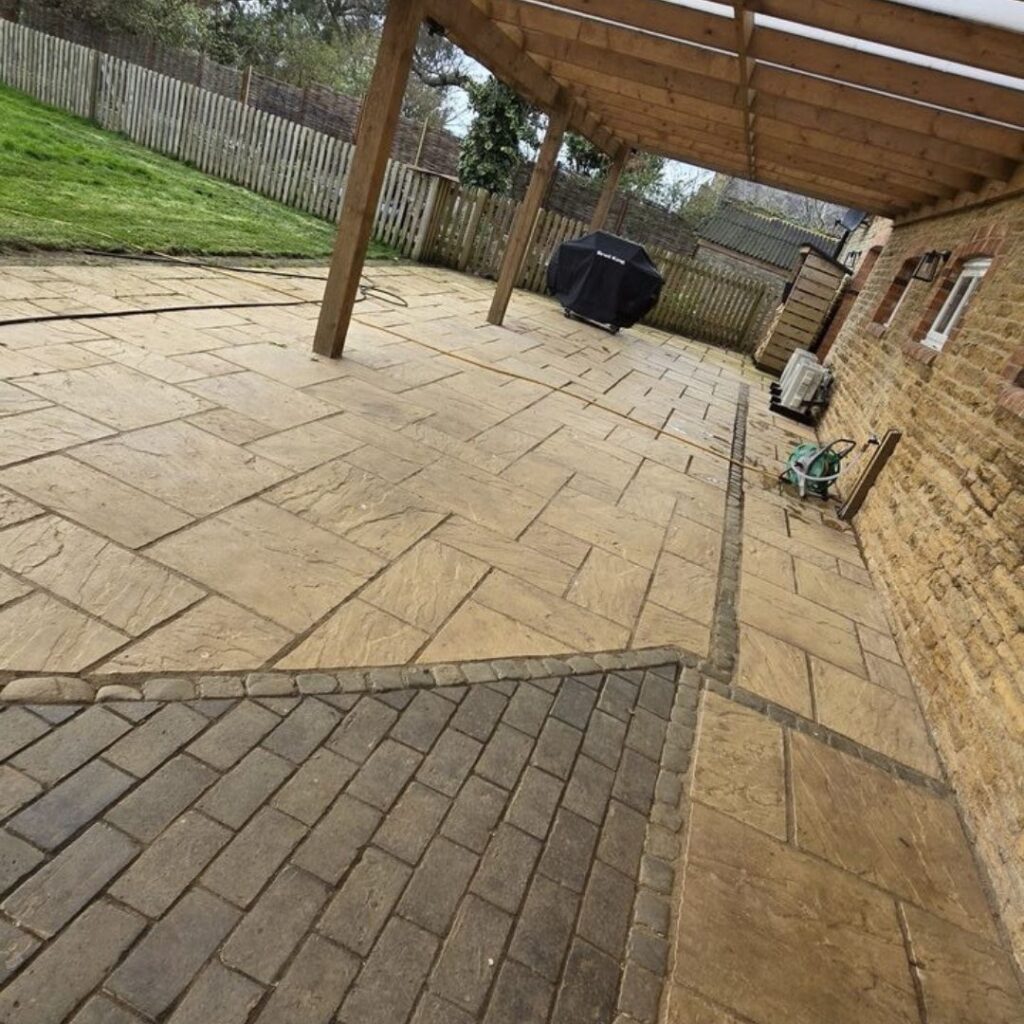
Weeds in a driveway are treated as a cosmetic nuisance and they are actually a structural one. A root system growing in a paving joint exerts real force, widening the gap, displacing jointing sand and eventually lifting or tilting the units around it. Once a joint is open, water enters the laying course, silt washes in and the pavement begins to move under load. Removing the visible growth without addressing the root simply resets a process that continues underneath. Effective driveway cleaning therefore begins with vegetation management rather than water. A systemic treatment applied to actively growing weeds travels to the root and kills the whole plant, and it needs applying a week or two before the mechanical work for best effect. Pulling or burning removes the top only. Where moss has colonised the joints, a biocide is used instead, since moss has no root system to target and needs killing across its whole mass. Mechanical cleaning then follows. A rotary surface cleaner lifts biofilm and dirt evenly across blocks or slabs while removing the composted material sitting in the joints, which is what has been feeding the growth. That material is genuinely soil at this stage, rich enough to germinate anything that lands on it, and leaving it in place guarantees the problem returns. Reinstatement closes the loop. Once the surface is properly dry, kiln-dried sand is brushed diagonally into every joint and worked down until full. A tightly sanded joint gives new growth nowhere to establish and restores the interlock that gives block paving its strength. Where pointing on a slab patio has failed, that is flagged for repair rather than filled with sand, which would not hold. Edge restraints deserve a look too, since a driveway spreads outward at its perimeter once the edging has moved. Properties in Hornton with drives running alongside established planting see faster regrowth and benefit from a shorter interval.
Roof Cleaning Hornton
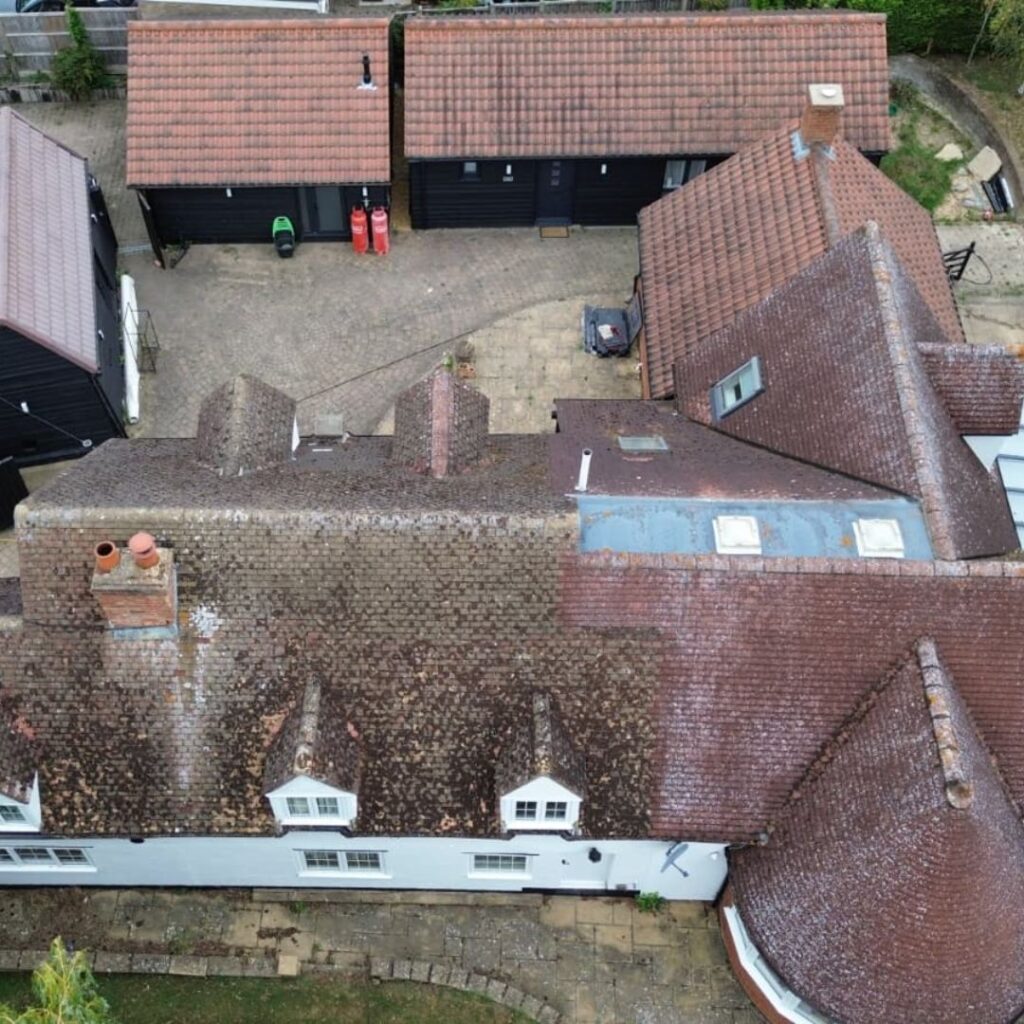
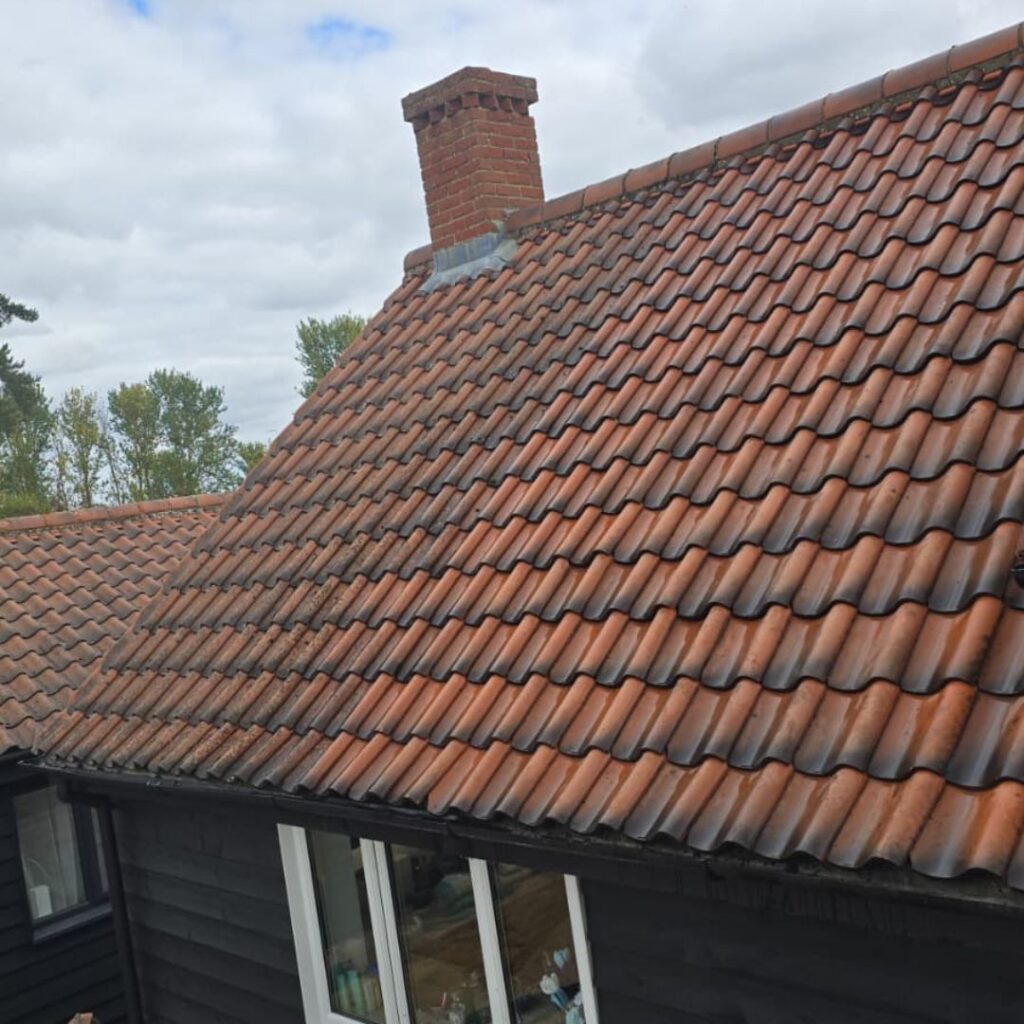
There is a straightforward way to judge whether a roof needs attention: look at the lower third of it after a wet spell. Water leaving the covering should run cleanly into the gutter. Where growth has built up in the laps, the lower courses stay visibly darker for far longer than the rest, because the moss is holding water against the tiles rather than letting it drain. That retained moisture is the mechanism behind almost every problem a roof develops from the outside in. The treatment is unhurried and deliberate. Bulk moss and lichen are removed mechanically at low impact, worked downwards from the ridge so that material falls clear of the laps instead of being pushed beneath them. The quantity removed from a neglected roof surprises most owners and would block the drainage instantly if it were not cleared as work progresses, so gutters, valleys and hoppers are cleaned in parallel. A biocidal treatment then follows, applied at low pressure across the covering and left to work over an extended period. It kills spores at root level rather than removing only what is visible, which is why the roof continues to lighten for weeks and why regrowth is genuinely slowed. Owners expecting an immediate transformation are told plainly that this method works on a longer timescale and lasts correspondingly longer. High pressure has no place in any of it. Jetting a concrete tile removes its granular surface and leaves porous material that colonises faster than before. On clay it damages the fired face, on slate it drives water under the courses, and on any covering it risks shifting units out of alignment. Inspection runs alongside the cleaning. Ridge bedding, flashings, mortar fillets, verge condition and any slipped or cracked units are photographed and reported. Stone and older properties in Hornton often have detailing worth documenting before it fails rather than after.
Solar Panel Cleaning Hornton
The most common misconception about solar arrays is that rain keeps them clean. It removes some loose material, certainly, but rainfall is a rinse without agitation, and the residue it leaves behind concentrates at the lower edge of each panel where run-off slows against the frame. Over a few seasons that becomes a defined band of soiling sitting directly over the bottom row of cells, which is the worst possible place for it given how panels are wired. Everything else adds to the load. Fine dust from surrounding land, pollen in spring, tree debris, atmospheric particulates and bird fouling all settle on the glass and are held there by the same residue. Where the pitch is shallow, self-cleaning is minimal and the accumulation is more or less permanent. Moss will eventually establish along the frame edge, growing up onto the glass and shading cells continuously. Solar panel cleaning removes it without risking the installation. Purified, deionised water is fed through a telescopic pole to a soft brush head, so the glass is agitated gently and rinsed with water that leaves nothing behind as it dries. That absence of dissolved minerals is the whole point: mains water dries to spots and film, which then attracts the next layer of dust. Detergents are avoided for the same reason, and because residue can affect the anti-reflective coating. Constraints are observed strictly. No pressure is directed at the panels or the frame seals. Nobody stands on the glass. Work is scheduled for cooler parts of the day so that water never meets hot panels. Frame channels are cleared during the same visit, as trapped debris holds moisture against the seal and gives moss its foothold. Recording generation before and after gives a direct measure of the benefit, and the difference usually shows in monitoring data within a day. Arrays serving properties near Hornton typically justify annual attention, more where bird activity is persistent.

Our Customers Say Everything there is to know about us
EXCELLENTTrustindex verifies that the original source of the review is Google. Fantastic service through out! Our roof looks brand new! Decided to also get the driveway done after seeing the results of first job and what a difference! All for a reasonable price as well. Definitely highly recommend 5*Posted on GoogleTrustindex verifies that the original source of the review is Google. Brendan of Stewart Exterior Cleaning was superb. He obviously knows a lot about looking after the exterior of a property and when he visited to clean our gutters, he clearly explained what was going on and gave excellent advice for the future. He was also friendly and enthusiastic, and gave us the sense he enjoys his work and taking care of his customers. He also mentioned some of his company's other services such as landscape gardening, which probably explains why he has so much expertise. But as it was winter and just before Christmas when he visited, it wasn't the right time for things for the garden, but we'd like to have him back in the spring, so he's probably got a customer for life now! Thanks so much, Brendan – it's very obvious why your business is thriving and we'll be back in touch in the future!Posted on GoogleTrustindex verifies that the original source of the review is Google. Brendan was very helpful and informative, he was quick and efficient in completing the job while answering any questions I had, I would definitely recommend his servicesPosted on GoogleTrustindex verifies that the original source of the review is Google. Returning customer of Stewart Exterior Cleaning. Brendan did a gutter clear for us recently and came back today to carry out a repair caused by high winds. Very friendly servicePosted on GoogleTrustindex verifies that the original source of the review is Google. Great service, roof looks newPosted on GoogleTrustindex verifies that the original source of the review is Google. Great service, couldn’t be happier with the end result. We initially had Brendan in to pressure wash and re-sand our driveway and after seeing the excellent job he did, we decided to have the roof and gutters cleaned as well. The transformation has completely refreshed our home and added fantastic curb appeal. Reliable, friendly, and great value for the service provided thanks again, Brendan!Posted on GoogleTrustindex verifies that the original source of the review is Google. Excellent job completed by Brendan. Was prompt and went above and beyond - given that there wasn’t a useable tap on sight! Also advised what do do after cleaning with regards to paving slabs. Would highly recommend, very excellent price and top notch service. Thank you BrendanPosted on GoogleTrustindex verifies that the original source of the review is Google. Excellent job done in a most friendly and efficient manner. Would highly recommend Brendan and his company to anybody looking to have their gutters cleared and fascia’s cleaned. Well done Stewart Exterior Cleaning.Posted on GoogleTrustindex verifies that the original source of the review is Google. I spotted Brendan working at neighbours property and asked him for a quote to pressure wash my pathway and patio. We agreed a price and the work was carried out a few days later. Brendon is hardworking, friendly and diligent and I’m very happy with the outcome and overall experience.Posted on GoogleTrustindex verifies that the original source of the review is Google. Fantastic service from Stewart Cleaning Ltd. Great work, tidy and very accommodating. Would definitely recommend and will definitely be using these guys again. Thank you! Noticed my dirty windows and even cleaned them despite it not being part of the booked job! Many many thanks.
Gutter Cleaning Hornton
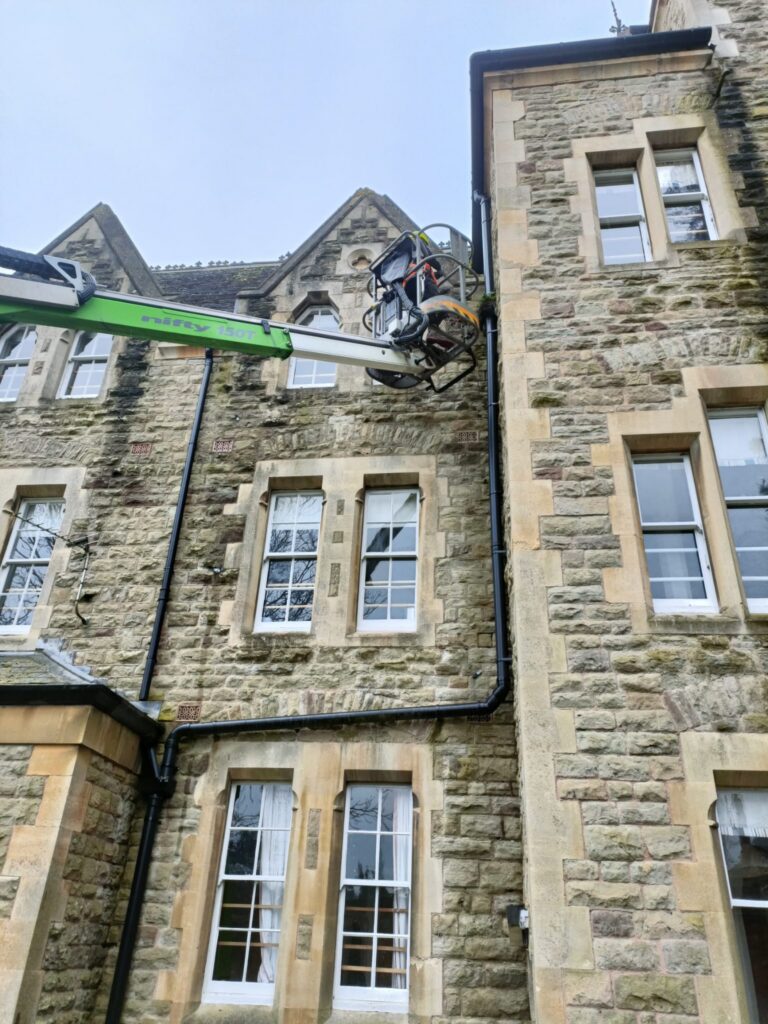
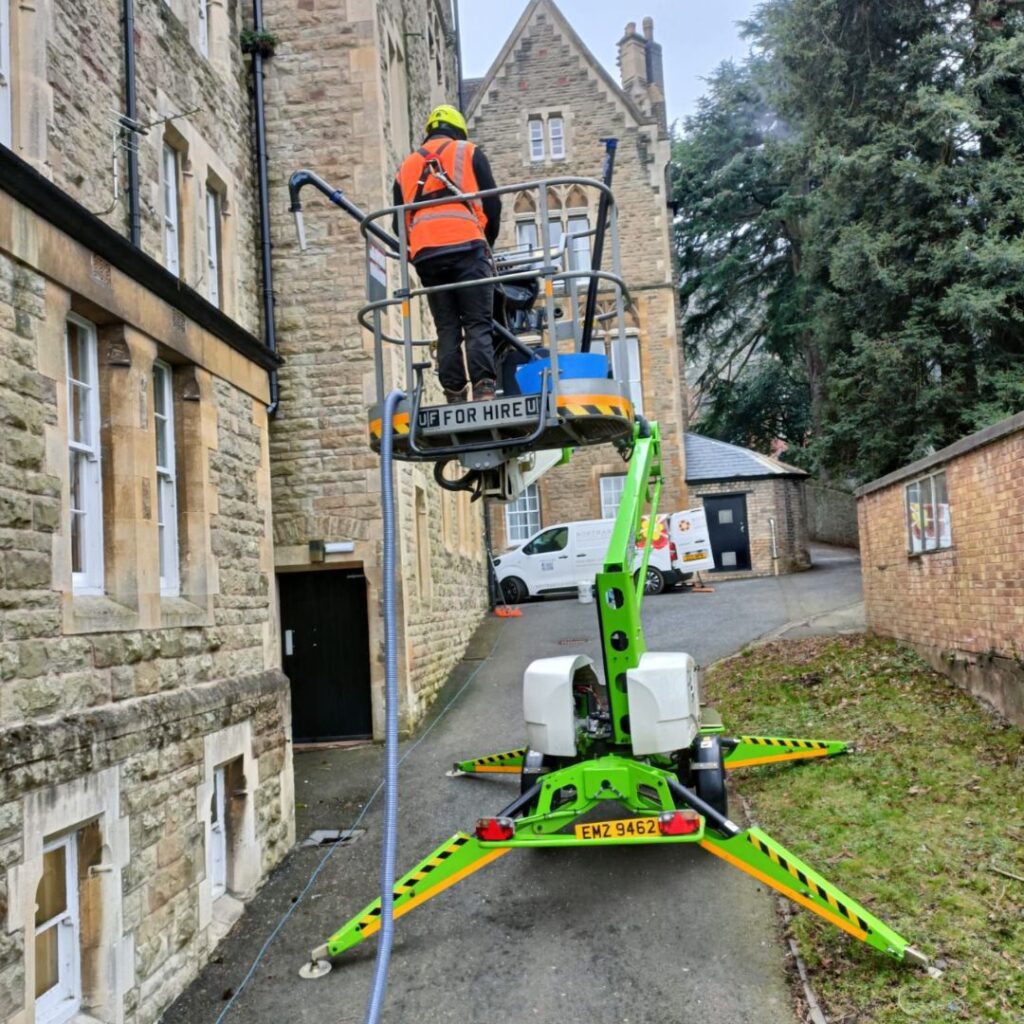
Gutter maintenance is the cheapest insurance available on a building, and neglecting it is the most reliable way to convert a minor issue into a structural one. The channel itself is inexpensive; what it protects is not. Fascia, soffit, eaves timbers, wall plate, masonry and internal finishes all depend on rainwater being collected and carried away rather than allowed to run down the building. Failure develops in stages that are easy to spot once known. Leaf litter and roof moss accumulate and compact. Silt collects against the deposit and the channel begins to hold water. Weight increases and brackets take load they were not designed for, so the run sags between fixings and holds water permanently. Seed germinates in the standing organic material. Water spills over the front edge in heavy rain and runs down the wall, and behind the gutter it wicks into the fascia board where nothing can be seen at all. Modern gutter cleaning uses high-reach vacuum equipment for good reason. A suction head on carbon fibre poles draws compacted material straight into a sealed drum at ground level, so work is done without ladders on soft ground and without dropping sludge onto planting and paving. A camera at the pole head shows the interior of the run, allowing joints, brackets and residual silt to be assessed properly. Where deposits have set hard or access from the ground is impossible, ladder or tower work handles the remainder. Downpipes are flushed individually and discharge confirmed at the gully. Hoppers and offset bends receive particular attention, as they collect material where it cannot be seen. Sagging sections and loose brackets are reported, since these guarantee an early re-block. Fascias and soffits are washed while the access is in place. Older properties in Hornton with cast iron rainwater goods need their joints checked carefully during the same visit.

Render Cleaning Hornton
A rendered elevation is essentially a controlled, porous skin, and everything about its behaviour follows from that. The texture holds moisture. The moisture supports algae and lichen. The growth holds more moisture. Once that cycle establishes, the wall never fully dries, and a render system that cannot dry cannot perform as designed. Freeze-thaw action within a permanently damp surface produces crazing and, eventually, sections that sound hollow when tapped. Recognising the stage matters. Early colonisation shows as a light green tint on shaded elevations, most often below sill level and along the gable. It is easily reversed at that point. Established growth appears as defined dark patches with a slightly furred surface and takes longer to treat. Advanced colonisation, with lichen embedded into the texture and black staining across a whole elevation, is still treatable but the wall beneath should be checked for damage first. Soft washing is the appropriate method throughout. A biocidal solution is applied at very low pressure, thoroughly wetting the surface without any abrasion, and then left to act. Growth is killed at cellular level and weathers off gradually, so the wall keeps improving for weeks after the visit and regrowth is markedly slower than after any mechanical clean. Nothing touches the finish, which means the texture and colour are unchanged. Pressure washing render produces the opposite outcome and is the single most common way a good wall is ruined. It removes finish along with growth, leaving lighter, rougher patches that hold dirt more readily and cannot be blended back into the surrounding surface. Prevention extends the interval usefully. Guttering that discharges properly removes the main cause of vertical staining. Planting trimmed back from the base improves airflow. Where an elevation is permanently shaded, a protective treatment after cleaning slows recolonisation. Rendered walls in Hornton facing away from the sun are the ones that will need attention first.