Exterior Cleaning South Newington | Pressure Washing South Newington
- Residential & Commercial Cleaning Specialists
- 5-Star Rated Service & Customer Care
- Eco-Friendly Cleaning Solutions
- Expert Team Covering South Newington
Get a FREE Quote
Exterior Cleaning South Newington
Neglect on a building follows a timetable, and setting it out makes the case for maintenance better than any argument about appearance. In the first year or two after a property is finished, or after it has been properly cleaned, very little appears to happen at all. Surfaces shed water, dry between rainfall and look much as they did. Colonisation is beginning invisibly on the shaded elevations, but nothing shows. By around year three, the shaded faces have a light green cast, joints in paving have darkened and the roof carries a faint mottling in the laps. Everything at this stage lifts easily with a dilute treatment, and the cost of intervening is trivial. By year five to seven, growth is established. Render carries defined patches, paving is green across its shaded portions with weeds rooted in joints that have lost their sand, and moss is visible along the roof’s lower courses. Gutters are holding a compacted deposit. Work at this point requires proper chemistry, dwell time and mechanical removal, and it costs several times what it would have at year three. By year ten and beyond, the damage begins. Jointing sand is gone and blocks rock underfoot. Water retained against render has crazed the surface. Moss in the roof laps has been through several dozen freeze-thaw cycles and the overlaps have opened. Fascia timber behind an overflowing gutter is rotten. Some of this is still cleaning work and some of it has become repair. Beyond fifteen years of neglect the arithmetic reverses entirely, and replacement of individual elements starts competing with restoration on cost alone. Stewart Exterior Cleaning sees properties at every one of those stages. Households in South Newington searching exterior cleaning near me are most often somewhere around year seven, which is retrievable but no longer cheap.
Pressure Washing South Newington
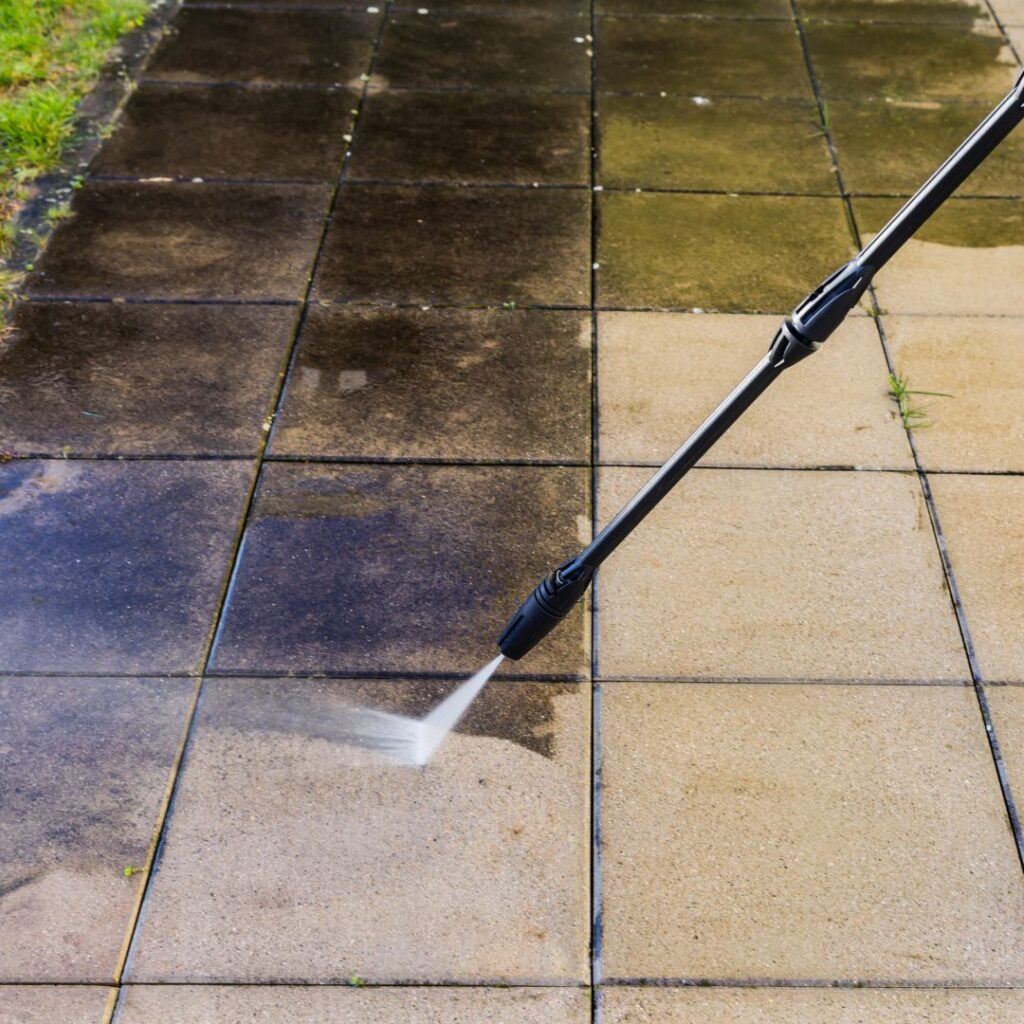
Concrete and hard landscaping deteriorate on a schedule of their own, and knowing where a surface sits on it explains what cleaning can and cannot achieve. A newly laid concrete surface has a smooth, dense layer at the top known as laitance, formed as fine cement paste rises to the surface during finishing. That layer is what gives new concrete its closed, even appearance and its resistance to water. Over years of frost, traffic and general weathering it erodes, exposing the aggregate beneath. That is not a fault and it is not dirt, and no amount of pressure will bring back a surface that has gone. Cleaning an old concrete drive produces a clean exposed-aggregate finish, which is the honest best outcome and worth explaining beforehand. Block paving follows a different curve driven almost entirely by jointing sand. Sand depletes continuously through rainfall, sweeping and every cleaning visit. While joints stay full, the pavement holds together through interlock. Once they drop below roughly two-thirds, load transfer between blocks starts failing, units move fractionally under traffic, edges chip and water reaches the laying course. From there, deterioration accelerates. Natural stone weathers according to its bedding structure rather than its age alone. Sedimentary flags contain softer bands that erode faster than the harder ones, and over-pressuring accelerates the process into visible pitting within a single visit. The practical conclusion is that pressure washing should be doing less work as a surface ages, not more. Older materials get longer chemical dwell and gentler rinsing, with a flat surface cleaner keeping the energy consistent rather than concentrated wherever a lance happens to point. Reinstatement matters more with age too, since older joints hold sand less readily. Anyone booking pressure washing near me for an ageing drive in South Newington should ask what the realistic finished appearance will be.
Are you based in South Newington or the Surrounding Areas?
Patio & Driveway Cleaning South Newington
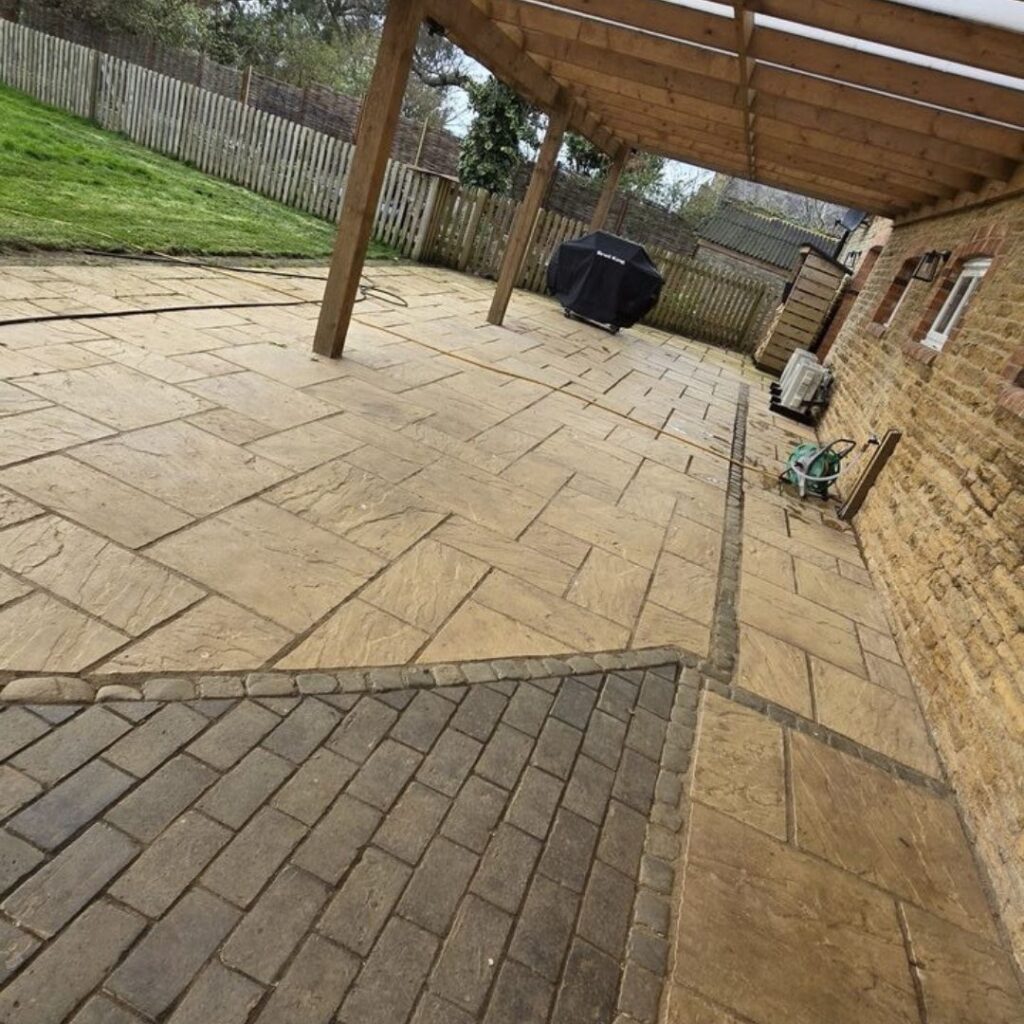
A driveway left alone passes through recognisable stages, and catching it early is the difference between a wash and a rebuild. At first the joints darken, which nobody notices. Then a thin green film appears on the shaded portions, usually nearest a wall or beneath planting, and the surface becomes slightly slippery after rain. At this stage a proprietary biocide applied with a watering can, once a year, would keep the problem from developing at all. Next, organic material accumulates in the joints. Leaf litter, silt and dead moss compost down into what is effectively soil, and seed germinates in it. Weeds appear, and pulling them removes the top growth while leaving a root system that returns within weeks. The joints are now holding water rather than draining, so growth accelerates. Then, at some point nobody observes, the jointing sand goes. Repeated rainfall, sweeping and any previous cleaning has taken it, and once joints drop below two-thirds full the interlock that gives block paving its strength begins to fail. Blocks move fractionally under load, edges chip, gaps widen and water reaches the laying course beneath. After that the sub-base takes water it was not designed to carry, and settlement follows. Blocks rock underfoot, low spots pond, and the ponding feeds growth continuously. At this point cleaning produces a clean driveway that is still structurally compromised, and the honest advice is that lifting and relaying the affected area is the actual remedy. Catching it before the sand goes keeps the whole thing in the realm of maintenance. Cleaning removes the composted joint material, weeds are treated systemically a week or two ahead so the roots die rather than the tops, and kiln-dried sand is reinstated once the surface is dry. Householders in South Newington booking driveway cleaning near me should look at their joints first.
Roof Cleaning South Newington
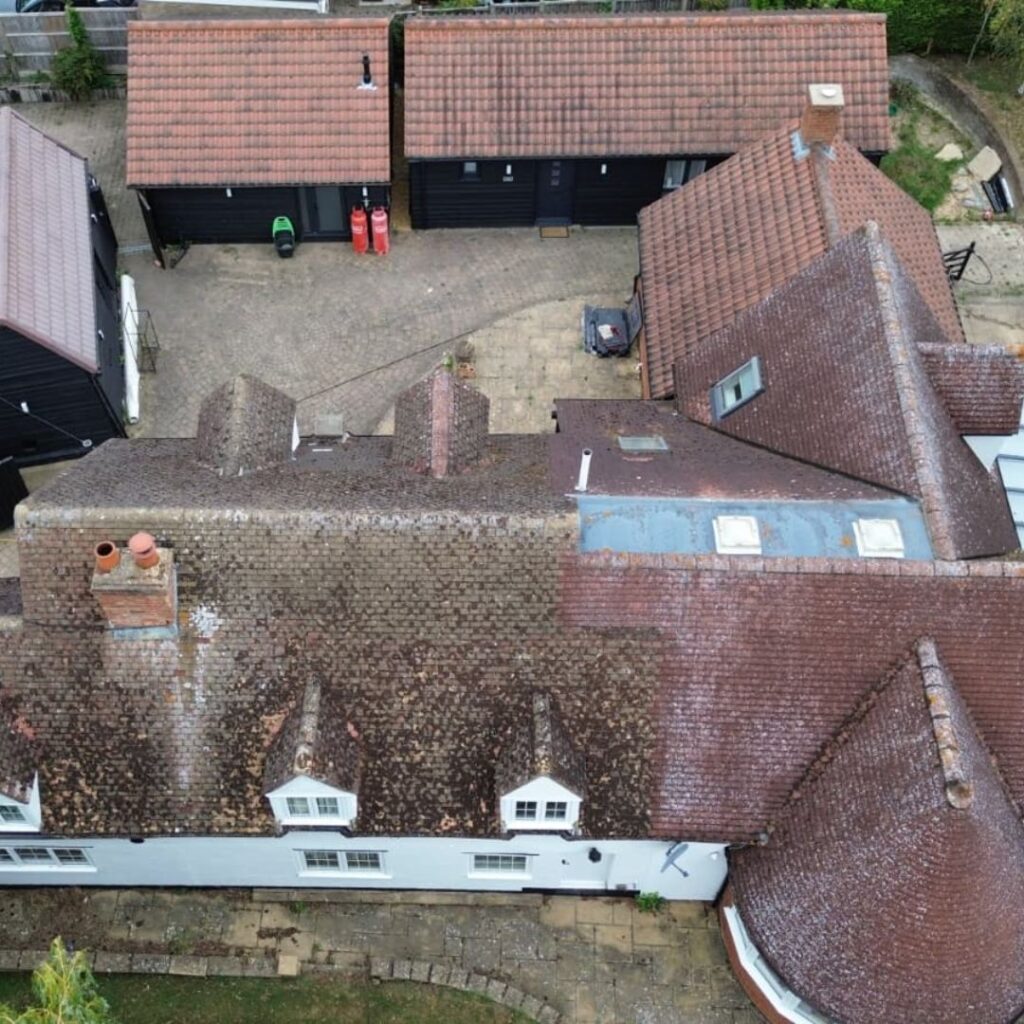
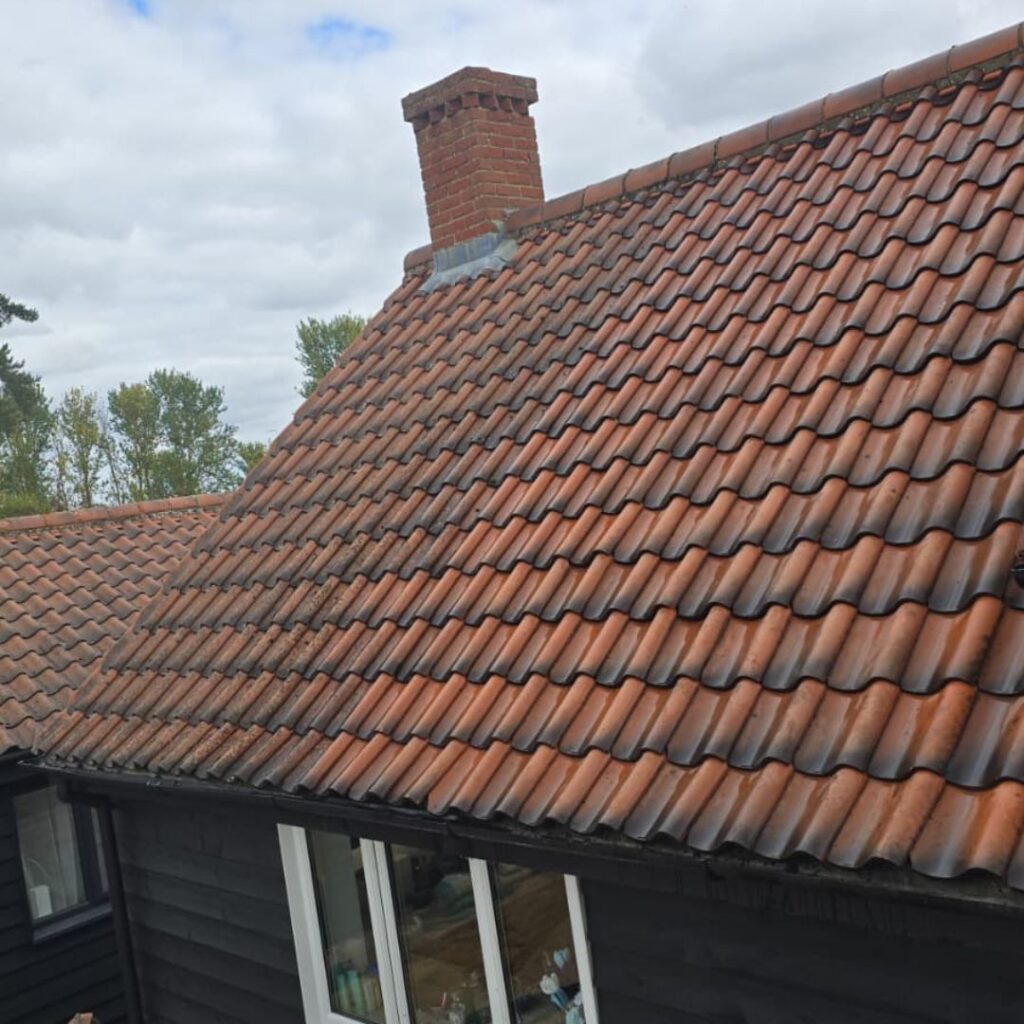
Damage to a roof from organic growth accumulates over decades and it does so in a sequence worth knowing. It begins with spores settling in the overlaps, where moisture lingers longest. Nothing is visible for the first several years. Then a faint mottling appears in the laps and along the ridge, thickening gradually as the growth traps more moisture and creates better conditions for itself. Once established, the moss holds water against the units continuously. Capillary action draws that water sideways and upward into the overlap, reaching battens and underlay never intended to stay damp. On a concrete tile roof the granular surface, already weathering off with age, disappears faster beneath a permanently wet mat, and the exposed concrete underneath is porous and colonises quicker still. Frost then supplies the mechanical force. Water held within growth wedged into a lap expands as it freezes, prising the units apart by a fraction. Repeated through several dozen cycles each winter over decades, those fractions become permanent openings. Meanwhile the growth sheds continuously into gutters and valleys, compacting with silt into deposits that block drainage. A partially blocked valley forces water to spread across the covering and back under the tiles at the junction, which is a common origin for a leak wrongly attributed to a slipped tile. Correct treatment interrupts the sequence. Bulk moss is removed by hand with soft-bladed tools, worked downward from the ridge so material falls clear of the laps, with gutters and valleys cleared in parallel. A biocide follows at low pressure and is left to act over subsequent weeks, killing spores so regrowth is genuinely slowed. High pressure is never used, since it drives water into the exact space the work is meant to protect. Roofs in South Newington that have gone twenty years untreated show every stage at once.
Solar Panel Cleaning South Newington
Soiling on a solar array builds gradually enough that owners rarely notice, and the pattern it follows explains why the losses grow faster than the dirt does. In the first months after installation, generation matches the expected figures and the glass stays essentially clear of anything rainfall cannot handle. Fine dust settles and rainfall removes most of it, since a clean panel sheds water readily. Within a year or two, a residue line establishes at the lower edge of each panel. Run-off slows as it reaches the frame and deposits whatever it has carried down the glass, and because that edge never gets the scouring flow the upper part receives, the deposit stays. It also provides a slightly rough surface that holds the next layer more readily than clean glass would. By year three or four, that line has become a defined band sitting over the bottom row of cells. This is where the losses become disproportionate, because cells within a panel are wired in series and the current through the whole string is limited by its most obscured cell. A narrow band therefore costs far more than its area suggests. Beyond that, moss establishes in the frame channel where debris and moisture collect, growing upward onto the glass edge and shading cells permanently. At the same point, standing organic material in that channel starts working against the seal between glass and frame. Cleaning at any stage reverses the soiling, using purified deionised water fed through a carbon fibre telescopic pole to a soft brush, agitating lightly and rinsing continuously so the glass dries completely clear. No detergent, no pressure at the seals, nobody on the modules, and work timed for cooler conditions. Frame channels are cleared in the same pass. Arrays in South Newington on shallow pitches reach that third stage soonest.

Our Customers Say Everything there is to know about us
EXCELLENTTrustindex verifies that the original source of the review is Google. Fantastic service through out! Our roof looks brand new! Decided to also get the driveway done after seeing the results of first job and what a difference! All for a reasonable price as well. Definitely highly recommend 5*Posted on GoogleTrustindex verifies that the original source of the review is Google. Brendan of Stewart Exterior Cleaning was superb. He obviously knows a lot about looking after the exterior of a property and when he visited to clean our gutters, he clearly explained what was going on and gave excellent advice for the future. He was also friendly and enthusiastic, and gave us the sense he enjoys his work and taking care of his customers. He also mentioned some of his company's other services such as landscape gardening, which probably explains why he has so much expertise. But as it was winter and just before Christmas when he visited, it wasn't the right time for things for the garden, but we'd like to have him back in the spring, so he's probably got a customer for life now! Thanks so much, Brendan – it's very obvious why your business is thriving and we'll be back in touch in the future!Posted on GoogleTrustindex verifies that the original source of the review is Google. Brendan was very helpful and informative, he was quick and efficient in completing the job while answering any questions I had, I would definitely recommend his servicesPosted on GoogleTrustindex verifies that the original source of the review is Google. Returning customer of Stewart Exterior Cleaning. Brendan did a gutter clear for us recently and came back today to carry out a repair caused by high winds. Very friendly servicePosted on GoogleTrustindex verifies that the original source of the review is Google. Great service, roof looks newPosted on GoogleTrustindex verifies that the original source of the review is Google. Great service, couldn’t be happier with the end result. We initially had Brendan in to pressure wash and re-sand our driveway and after seeing the excellent job he did, we decided to have the roof and gutters cleaned as well. The transformation has completely refreshed our home and added fantastic curb appeal. Reliable, friendly, and great value for the service provided thanks again, Brendan!Posted on GoogleTrustindex verifies that the original source of the review is Google. Excellent job completed by Brendan. Was prompt and went above and beyond - given that there wasn’t a useable tap on sight! Also advised what do do after cleaning with regards to paving slabs. Would highly recommend, very excellent price and top notch service. Thank you BrendanPosted on GoogleTrustindex verifies that the original source of the review is Google. Excellent job done in a most friendly and efficient manner. Would highly recommend Brendan and his company to anybody looking to have their gutters cleared and fascia’s cleaned. Well done Stewart Exterior Cleaning.Posted on GoogleTrustindex verifies that the original source of the review is Google. I spotted Brendan working at neighbours property and asked him for a quote to pressure wash my pathway and patio. We agreed a price and the work was carried out a few days later. Brendon is hardworking, friendly and diligent and I’m very happy with the outcome and overall experience.Posted on GoogleTrustindex verifies that the original source of the review is Google. Fantastic service from Stewart Cleaning Ltd. Great work, tidy and very accommodating. Would definitely recommend and will definitely be using these guys again. Thank you! Noticed my dirty windows and even cleaned them despite it not being part of the booked job! Many many thanks.
Gutter Cleaning South Newington
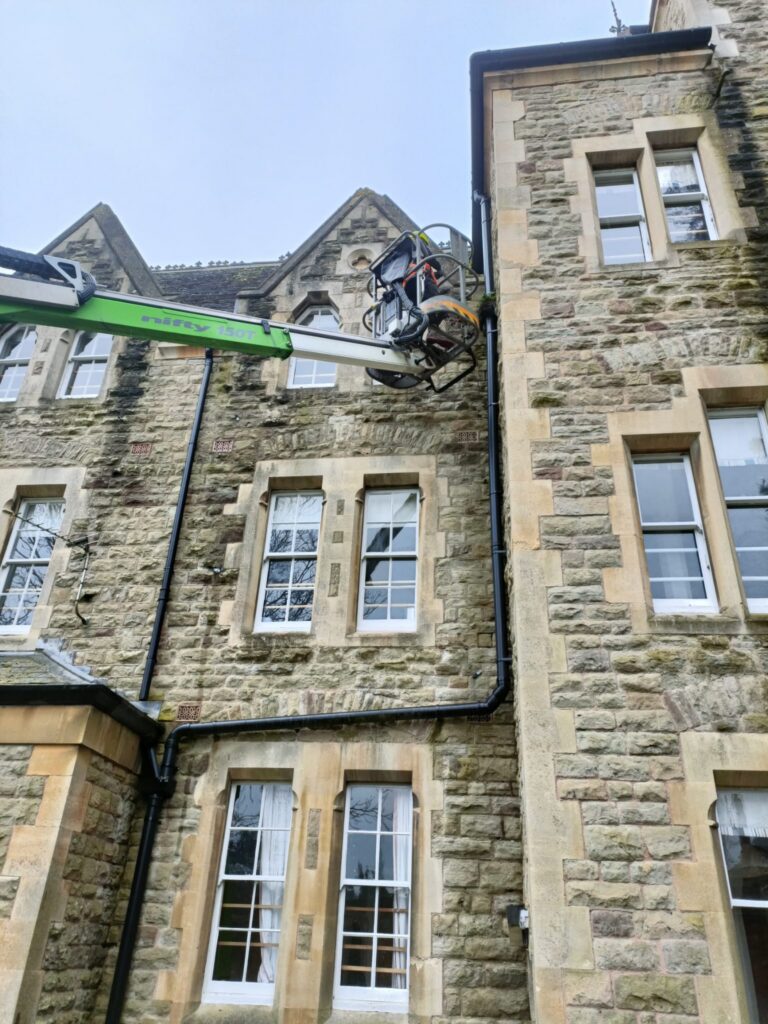
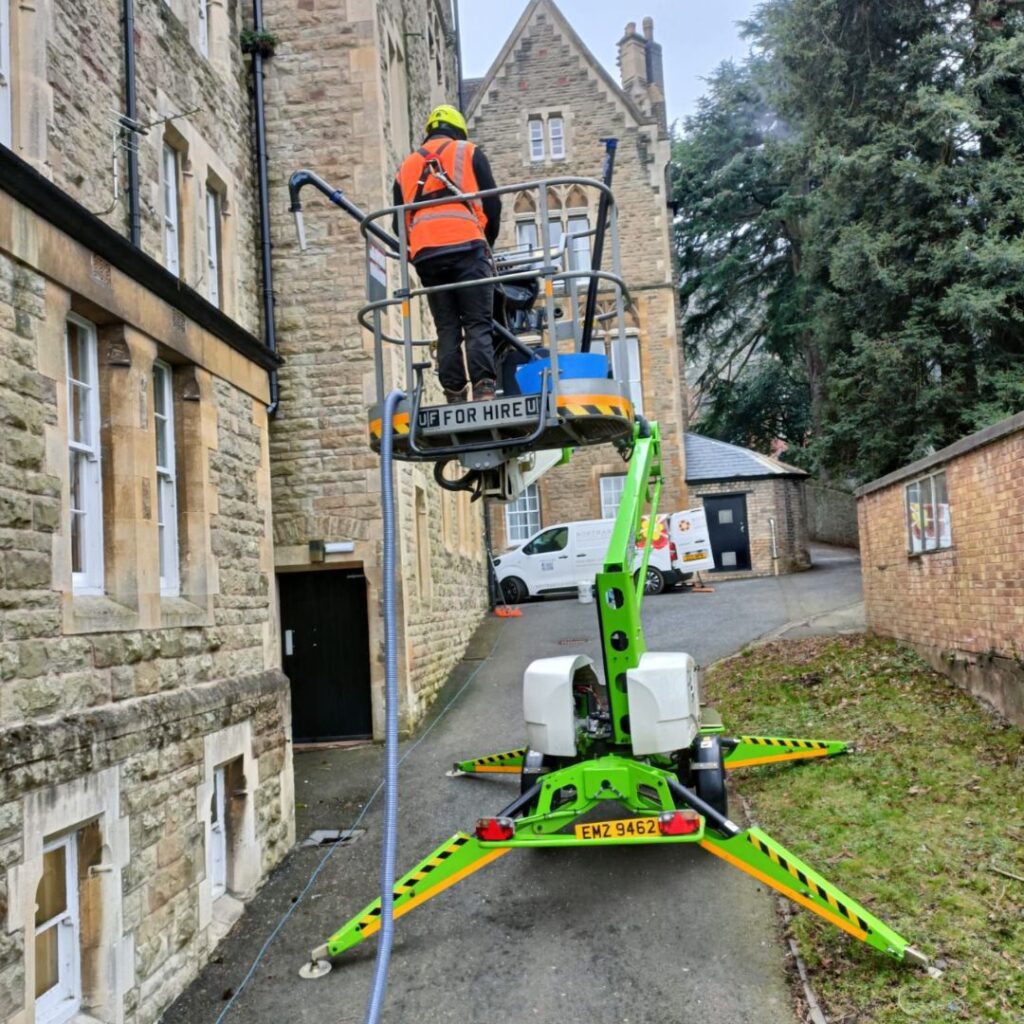
Guttering fails by degrees, and each stage makes the next one arrive faster. It starts with a modest scattering of leaf litter and roofing grit that ordinary rainfall cannot flush through to the outlet. Silt collects against it. Moss washed off the covering adds bulk and, crucially, holds water, so the deposit stops drying out between rainfall and begins to compact under its own weight. Once that material has compacted, the channel no longer carries anything close to its design capacity. Water backs up during heavy rain and spills over the front lip, and behind the gutter it wicks into the fascia board, which is usually timber behind a uPVC cover. Nothing about that is visible from the ground. The weight then becomes a problem in itself. A saturated deposit running the length of a gutter loads brackets designed for the channel and the water passing through it, and the run sags between fixings. A sagging section holds standing water permanently, which guarantees rapid re-blocking and provides germinating conditions for seed. Plants growing along a gutter line mean this stage has been reached and passed. Meanwhile the overflow is doing its own work. Masonry saturated repeatedly opens up under freeze-thaw. Internal plaster registers damp at first-floor level. Paving beneath develops a permanently green, permanently slippery strip. Fascia timber rots quietly for years. Clearance at any stage uses high-reach vacuum equipment, drawing compacted material into a sealed drum at ground level through carbon fibre poles, with a camera at the head showing the run before and after so joints, brackets and residual silt can be assessed. Downpipes are flushed individually and discharge confirmed at the gully. Sagging runs are reported rather than quietly re-cleared, since they will re-block whatever is done. Properties in South Newington with long unbroken runs reach that stage soonest.

Render Cleaning South Newington
Render discolours on a predictable timetable, and the point at which it is treated determines both cost and outcome. For the first two or three years a newly rendered elevation stays essentially clean, though colonisation is already beginning quietly within the texture of the shaded faces. Nothing shows because the growth is thin and the colour of the finish still dominates. By year four or five, a light green cast appears across the elevations that dry slowest, typically below sill level and along any sheltered gable. At this stage a dilute soft wash clears it entirely and quickly, and the interval before the next treatment will be a long one. By year eight or ten, growth is established as defined patches with a slightly furred texture, and lichen has begun rooting into the surface. Black streaking appears where water tracks repeatedly from a gutter joint or an unprotected sill. Treatment now needs a stronger dilution and longer dwell, and clearing takes several weeks rather than a fortnight. Beyond that point, the damage to the finish itself begins in earnest. A finish held permanently damp by a mat of growth cannot dry and cycle as designed, and freeze-thaw within a saturated surface produces crazing and eventually sections that sound hollow when tapped. At that point the wall needs repair before it needs cleaning, since applying liquid to a compromised render pushes water into the substrate behind it. Soft washing remains the method throughout, applied at very low pressure through a fan tip or pole-mounted lance and left to work, with the wall clearing progressively over subsequent weeks. What changes with neglect is the strength required, the time it takes and whether repairs are needed first. Rendered elevations in South Newington that are both shaded and sheltered move through those stages fastest.