Exterior Cleaning Williamscot | Pressure Washing Williamscot
- Residential & Commercial Cleaning Specialists
- 5-Star Rated Service & Customer Care
- Eco-Friendly Cleaning Solutions
- Expert Team Covering Williamscot
Get a FREE Quote
Exterior Cleaning Williamscot
A typical house presents at least six distinct materials to anyone cleaning its exterior, and each one has its own rules. Facing brick is dense and tolerant but its mortar joints may not be. Render carries a designed texture and, increasingly, colour held in a thin outer layer. uPVC fascias, cladding and frames oxidise into a chalky grey film that ordinary washing will not touch. Timber, whether painted, stained or bare, absorbs water and swells. Roof coverings are laid in overlapping courses that water must never be driven beneath. Paving is dense but bedded on material that can be washed out from below. Working across all six in a single visit is what exterior cleaning actually involves, and it is why a one-machine approach fails. The correct sequence starts at the highest point and works down, so that soiling released above never contaminates completed work below. Each material is then matched to a method: mechanical force where the substrate is hard and dense, chemistry and dwell time where it is porous or coated, and pure water with soft agitation where the surface is delicate or at height. Assessment happens before anything is switched on. Pointing is checked for softness and gaps. Sealant around window and door openings is examined, because a perished bead is an open route for water. Cladding fixings, loose trim and cracked units are recorded and reported. Vents, extractor outlets, alarm boxes and external electrics are covered. Planting is soaked and sheeted so that any drift is diluted before it reaches root level. Owners of older properties around Williamscot often assume their walls are too fragile to be cleaned at all, which is rarely true. It simply means the mechanical options are off the table and the work is done chemically, at low pressure, over a longer timescale. Searching for exterior cleaning near me and choosing on price alone tends to bring the opposite approach, and the results are difficult to put right.
Pressure Washing Williamscot
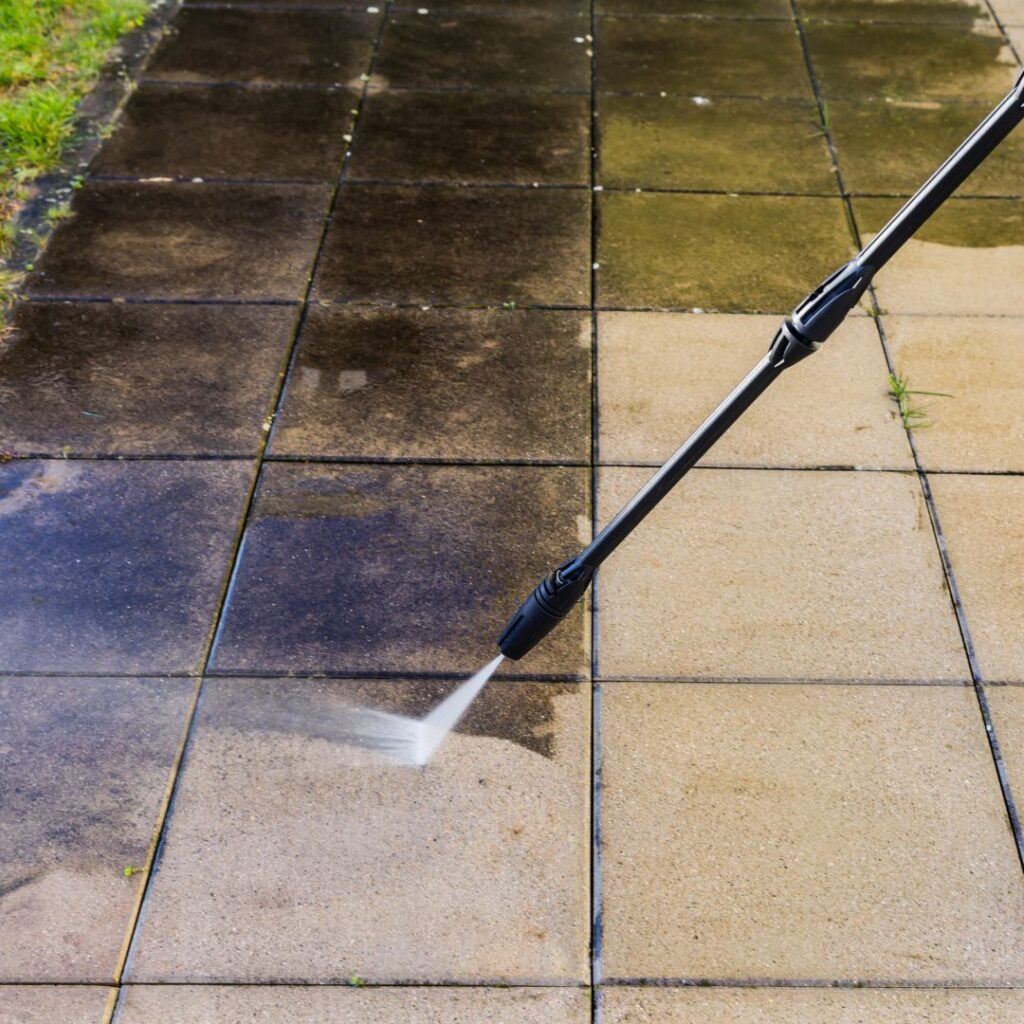
Protection is the part of pressure washing that nobody photographs and everybody notices when it has been skipped. Before a machine runs, drains and gullies are covered or fitted with a filter sock, air bricks and vents are masked, external sockets and light fittings are sealed, and any door threshold at risk of water tracking inside is dammed. Vehicles are moved or sheeted. Planting adjacent to the working area is watered thoroughly first, because saturated soil absorbs far less of anything that reaches it. Technique then determines whether the finish is even. A lance held too close leaves visible cutting lines; held too far away it does nothing at all. The working distance is found on an inconspicuous test area and then held consistently, with each pass overlapping the last by roughly half its width. Working in one direction throughout, rather than sweeping back and forth, prevents the striped appearance that is the classic hallmark of rushed work. On large open areas a flat surface cleaner removes the variable entirely, since its shrouded rotating head maintains a fixed height and speed across the whole run. Operator safety is not a formality. A pressure washer jet will penetrate skin and cause injection injuries that look trivial and are anything but. Boots, eye protection and gloves are standard, the trigger is released whenever the lance is moved, and nobody works a lance from a ladder, where recoil and wet rungs combine badly. Where height is involved, a tower or pole system replaces the ladder altogether. Materials dictate limits regardless of what a customer would like. Where a wall in Williamscot is built with lime mortar or soft handmade brick, the pressure washer stays in the van and the work is done by soft washing instead. Anyone booking pressure washing near me for masonry should expect that conversation, and be wary of a contractor who does not raise it.
Are you based in Williamscot or the Surrounding Areas?
Patio & Driveway Cleaning Williamscot
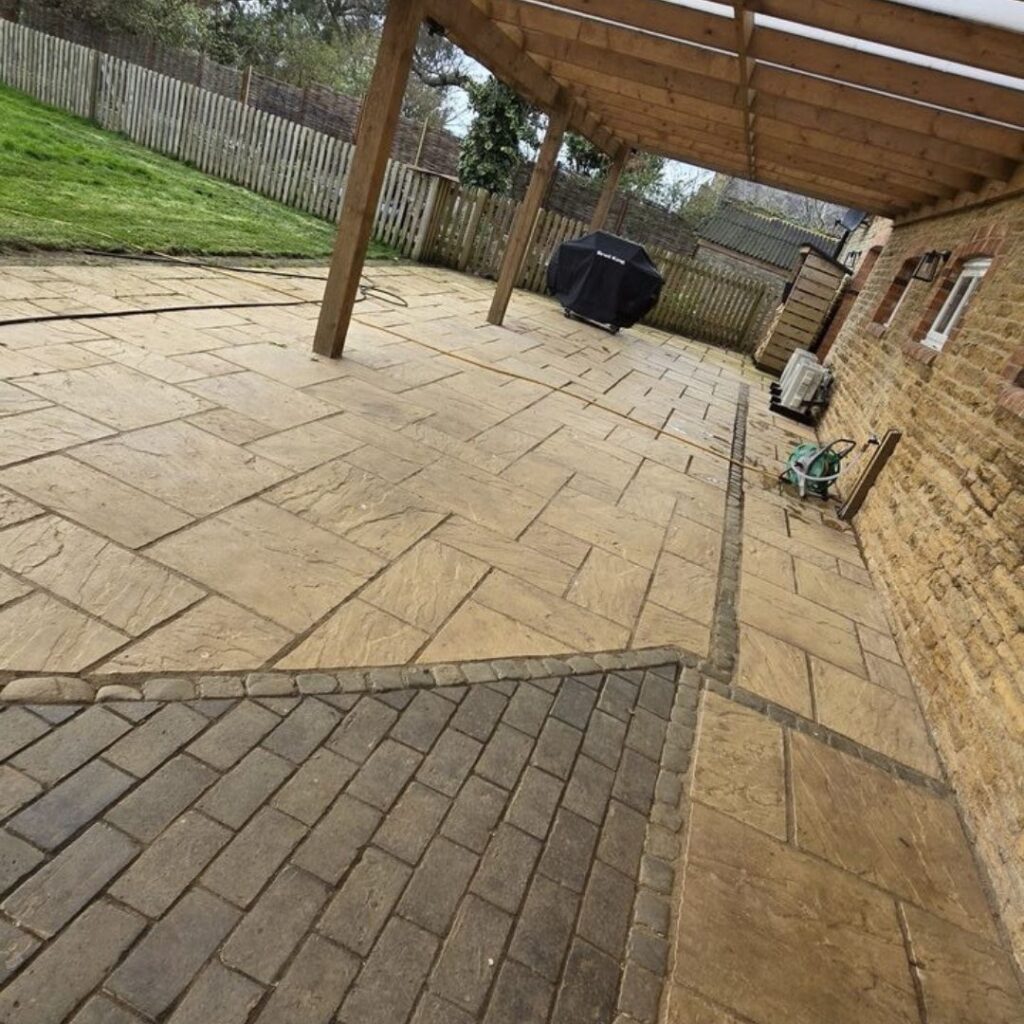
The single largest factor in how long a cleaned patio or driveway stays clean is what happens to the joints. Everything else is surface. A block pavement derives its strength from interlock, which depends on tightly filled joints transferring load between blocks. When jointing sand is depleted, load transfer fails, individual blocks begin to rock, edges chip and water penetrates to the laying course beneath. Cleaning without reinstating the sand accelerates all of it. The process therefore has two halves. Cleaning removes surface biofilm, ingrained dirt and the composted organic material sitting in the joints, using a rotary surface cleaner to keep the pass even and avoid the tiger-striping that free-hand lancing produces. The surface is then allowed to dry properly, which matters because kiln-dried sand will not flow into a damp joint. Once dry, sand is spread, brushed diagonally across the blocks so it enters rather than bridges the joints, and worked in until the joints are full to just below the chamfer. Slab and flagstone patios follow a different logic, since their strength comes from the bed rather than the joints. Here the concern is pointing. Cement pointing that has cracked or blown is identified before cleaning, as water driven into an open joint travels straight into the bedding below and causes the slab to rock. Where pointing is sound, a lower-pressure pass with a longer chemical dwell removes growth without cutting into the mortar. Concrete drives and hard standings tolerate the most direct treatment, though pattern-imprinted concrete is the exception and needs its own approach entirely, as the colour and release agent sit in a thin surface skin. Oil deposits anywhere are treated with a degreasing agent and dwell time rather than force, since pressure drives contamination deeper into the slab. Properties in Williamscot with a shaded frontage tend to green over faster and benefit from a shorter interval between visits.
Roof Cleaning Williamscot
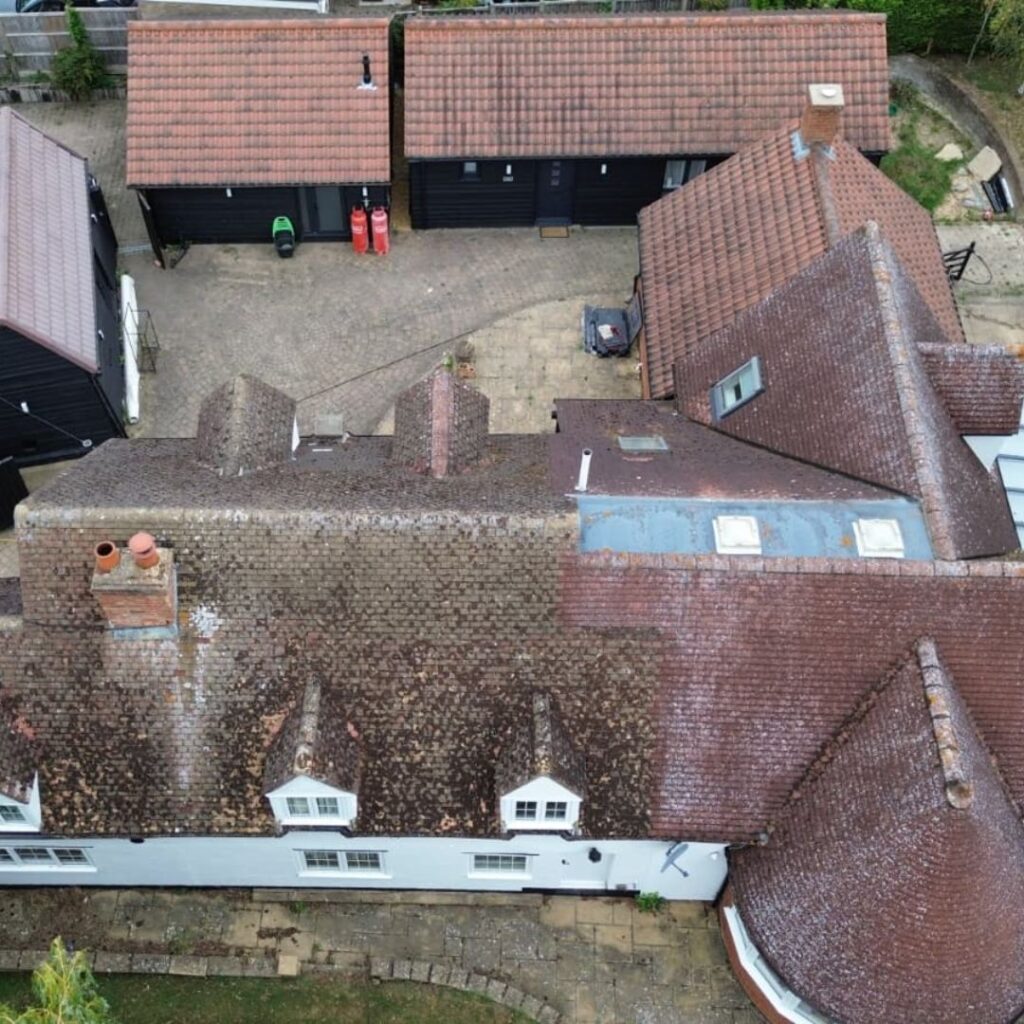
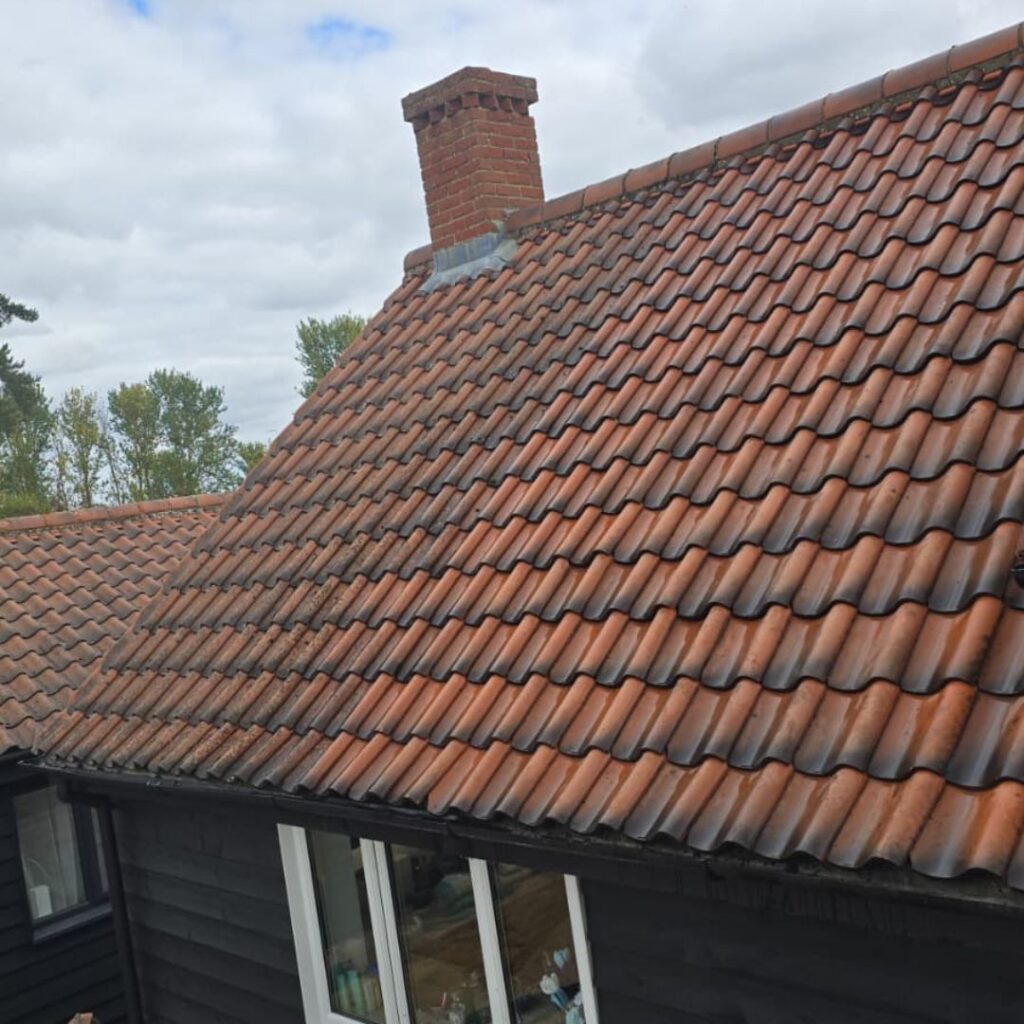
Getting to a roof safely is a larger part of the job than getting it clean. Pitch, height, covering condition and the ground available for equipment all feed into the access decision, and that decision is made before any price is confirmed. A low-pitched, sound covering with firm level ground alongside may be worked from a mobile tower. A steeper or fragile roof needs a properly footed scaffold with an edge protection system. Where the covering will not bear weight at all, the work is carried out entirely from poles at low pressure, without anyone setting foot on it. Roof ladders, correctly hooked over the ridge and used with a stable base ladder, remain appropriate for limited work on sound tiled roofs, but they are never used on slate of uncertain age, on fibre cement, or in wind. Ground conditions matter as much as the roof itself: a tower on soft or sloping ground is a hazard regardless of how good the equipment is. Once access is established, the cleaning itself is straightforward and unhurried. Moss and lichen are removed mechanically at low impact, working downward from the ridge so debris falls clear of the laps rather than being driven under them. Gutters and valleys are cleared as the work proceeds, because the volume of material coming off a neglected roof will block them immediately otherwise. A biocidal treatment then follows, applied at low pressure and left to act over subsequent weeks. While the access is in place, the covering is inspected properly. Slipped or cracked units, deteriorating ridge bedding, loose flashing, failed mortar fillets and daylight visible at a verge are all recorded and reported with photographs. Roof cleaning near me is often searched after a visible patch of moss appears, but the inspection frequently proves more valuable than the clean. Stewart Exterior Cleaning reports findings in Williamscot honestly whether or not there is further work in it.
Solar Panel Cleaning Williamscot
Not all soiling on a solar array behaves the same way, and the distinction changes how often cleaning is worthwhile. Uniform films of dust and pollen reduce output modestly and evenly across the whole panel. Localised, opaque contamination behaves far worse. Because cells within a panel are wired in series, one heavily shaded cell restricts current through the entire string it belongs to, so a bird dropping the size of a coin can cost far more generation than its area suggests. That disproportion is the main argument for regular attention rather than occasional deep cleans. Rural settings produce their own pattern. Airborne soil during ploughing and harvest, straw dust, pollen from surrounding trees and hedgerow debris settle in quantity, and much of it is fibrous enough to lodge against the lower frame rather than rinse off. Moss will establish in that band if it is left long enough, growing upward from the frame edge and permanently shading the bottom row of cells. The remedy is low-impact and repeatable. Deionised water is delivered through a telescopic pole to a soft brush, agitating the glass gently and rinsing away the loosened material. The absence of dissolved minerals in the water means it dries without spotting, so no film remains to catch the next layer of dust. Detergents are avoided entirely, since surfactant residue attracts soiling and can affect the anti-reflective coating on modern panel glass. Frame edges and the channel between glass and frame receive attention as part of the same pass, since that is where organic material accumulates and where standing water works against the seal. Nothing is pressure-washed, and nobody walks on the panels. For an installation near Williamscot, an annual clean is usually sufficient, with an additional visit where the array is close to trees or regularly subject to bird activity from adjacent buildings.

Our Customers Say Everything there is to know about us
EXCELLENTTrustindex verifies that the original source of the review is Google. Fantastic service through out! Our roof looks brand new! Decided to also get the driveway done after seeing the results of first job and what a difference! All for a reasonable price as well. Definitely highly recommend 5*Posted on GoogleTrustindex verifies that the original source of the review is Google. Brendan of Stewart Exterior Cleaning was superb. He obviously knows a lot about looking after the exterior of a property and when he visited to clean our gutters, he clearly explained what was going on and gave excellent advice for the future. He was also friendly and enthusiastic, and gave us the sense he enjoys his work and taking care of his customers. He also mentioned some of his company's other services such as landscape gardening, which probably explains why he has so much expertise. But as it was winter and just before Christmas when he visited, it wasn't the right time for things for the garden, but we'd like to have him back in the spring, so he's probably got a customer for life now! Thanks so much, Brendan – it's very obvious why your business is thriving and we'll be back in touch in the future!Posted on GoogleTrustindex verifies that the original source of the review is Google. Brendan was very helpful and informative, he was quick and efficient in completing the job while answering any questions I had, I would definitely recommend his servicesPosted on GoogleTrustindex verifies that the original source of the review is Google. Returning customer of Stewart Exterior Cleaning. Brendan did a gutter clear for us recently and came back today to carry out a repair caused by high winds. Very friendly servicePosted on GoogleTrustindex verifies that the original source of the review is Google. Great service, roof looks newPosted on GoogleTrustindex verifies that the original source of the review is Google. Great service, couldn’t be happier with the end result. We initially had Brendan in to pressure wash and re-sand our driveway and after seeing the excellent job he did, we decided to have the roof and gutters cleaned as well. The transformation has completely refreshed our home and added fantastic curb appeal. Reliable, friendly, and great value for the service provided thanks again, Brendan!Posted on GoogleTrustindex verifies that the original source of the review is Google. Excellent job completed by Brendan. Was prompt and went above and beyond - given that there wasn’t a useable tap on sight! Also advised what do do after cleaning with regards to paving slabs. Would highly recommend, very excellent price and top notch service. Thank you BrendanPosted on GoogleTrustindex verifies that the original source of the review is Google. Excellent job done in a most friendly and efficient manner. Would highly recommend Brendan and his company to anybody looking to have their gutters cleared and fascia’s cleaned. Well done Stewart Exterior Cleaning.Posted on GoogleTrustindex verifies that the original source of the review is Google. I spotted Brendan working at neighbours property and asked him for a quote to pressure wash my pathway and patio. We agreed a price and the work was carried out a few days later. Brendon is hardworking, friendly and diligent and I’m very happy with the outcome and overall experience.Posted on GoogleTrustindex verifies that the original source of the review is Google. Fantastic service from Stewart Cleaning Ltd. Great work, tidy and very accommodating. Would definitely recommend and will definitely be using these guys again. Thank you! Noticed my dirty windows and even cleaned them despite it not being part of the booked job! Many many thanks.
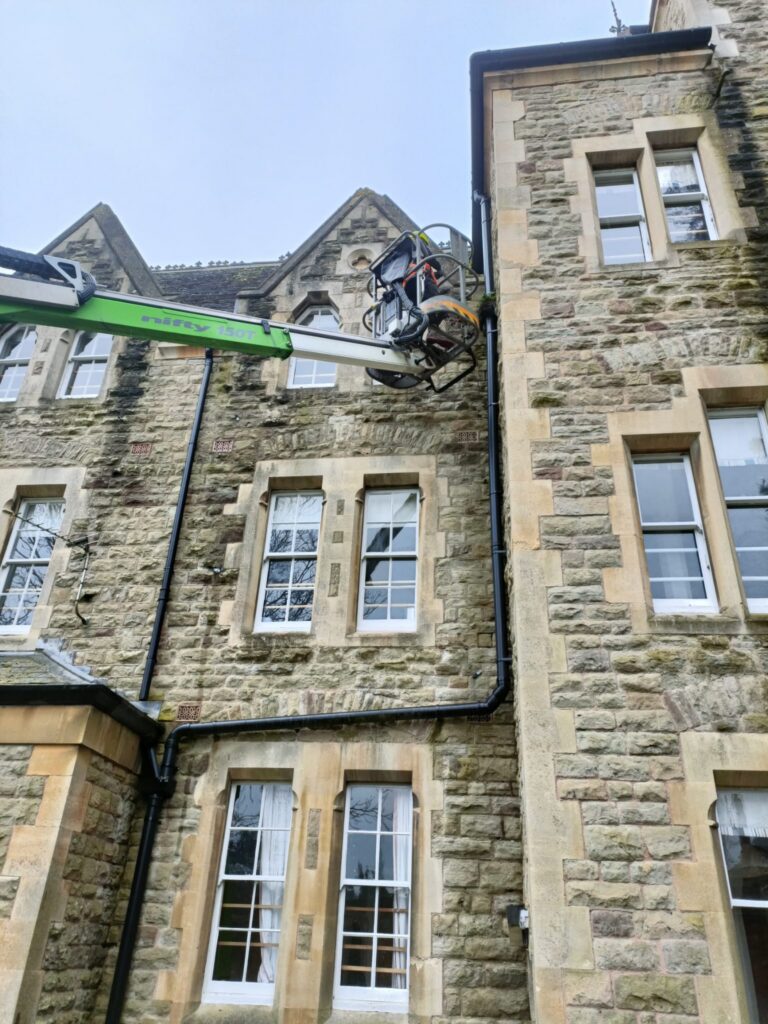
Gutter Cleaning Williamscot
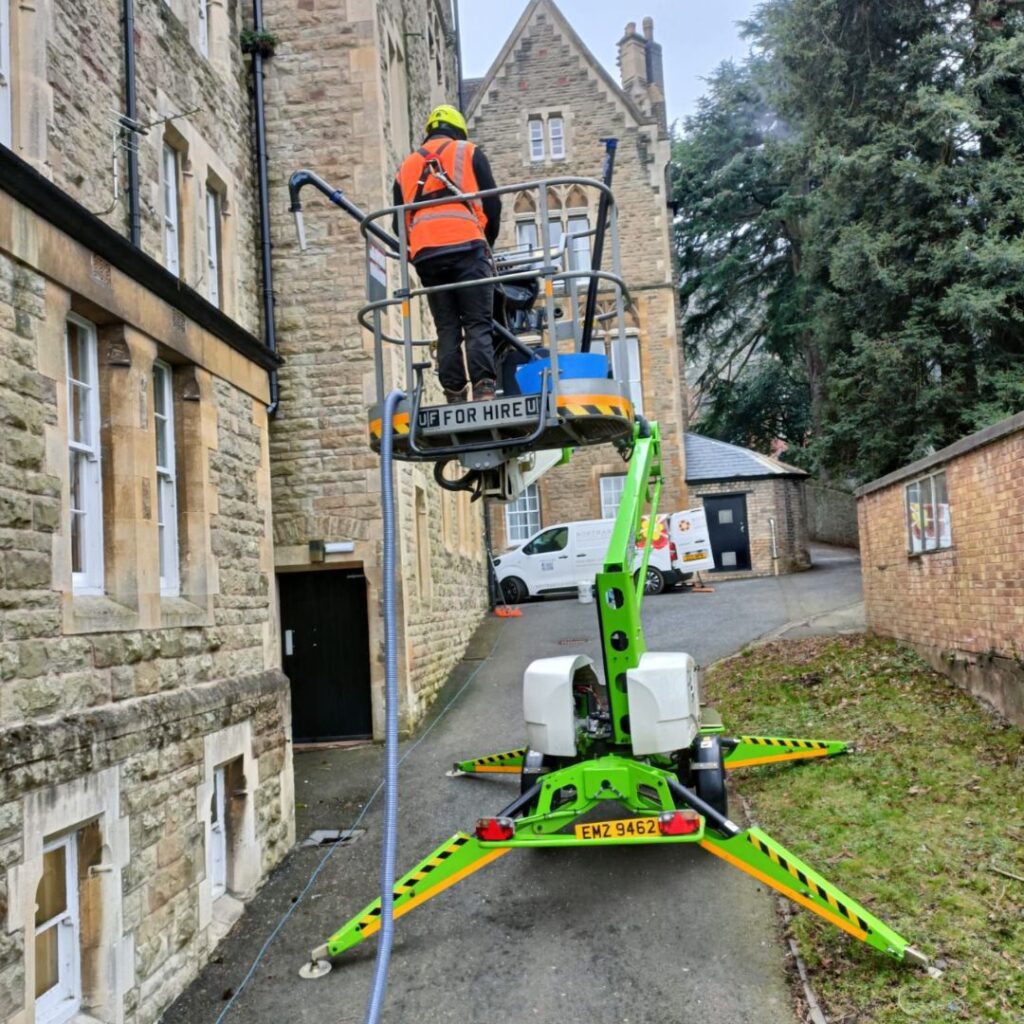
Timing determines how much of a gutter clean actually sticks. Late autumn, once the bulk of leaf fall has finished, is the obvious slot and clears the system before winter rainfall tests it. Spring is the less obvious but equally important one, dealing with the material that washed down from the roof covering over winter along with nesting debris and the seed and blossom that arrives in quantity in early summer. On properties with substantial tree cover, both visits are justified; on open, exposed properties a single annual clearance is often enough. The composition of what comes out varies with the season. Autumn debris is bulky, light and easily drawn out. Winter and spring material is very different: moss washed off a roof compacts with silt into a dense sludge that holds water and sets almost like mortar in the base of the channel. That deposit will not move under a hose and needs mechanical extraction. High-reach vacuum systems handle both. Carbon fibre poles carry a suction head to gutter level and remove material directly into a sealed drum at ground level, with a camera on the head providing a proper view along the run before and after. The work is done from the ground, keeping ladder use to a minimum on wet or uneven surfaces and preventing debris from being dropped onto paving or planting. Where deposits have set hard, or where a run cannot be reached from a suitable standing position, ladder or tower access is used for hand clearing and the result is inspected the same way. Every downpipe is flushed and the discharge confirmed, because a clean channel feeding an obstructed outlet fails in exactly the same way as one that was never touched. Brackets are checked for movement and sagging sections noted, since a run holding standing water will re-block quickly. Older properties in Williamscot with cast iron guttering need particular care over joint condition.

Render Cleaning Williamscot
What people usually want from render cleaning is the wall returning to its original colour, and the honest answer is that this depends on what is causing the discolouration. Organic growth clears completely with the correct treatment. Atmospheric grime lifts well. Staining caused by water tracking repeatedly over one line from a defective gutter or a missing sill drip will keep returning until the defect is fixed. Efflorescence, the white salt bloom that appears where moisture migrates through the render and evaporates at the surface, is a different phenomenon again and does not respond to biocide at all. Establishing which of these is present is the first task, and it is done by reading the pattern. Even greening across a whole elevation, worst on the shaded side, is straightforward biological colonisation. Vertical streaks with a defined edge point to a water path. Dark bands at low level suggest splash-back from paving below. Patchy white deposits mean salts. Each has a different remedy and only some of them are cleaning work. For biological growth, soft washing is the method. A biocidal solution is applied at very low pressure, wetting the surface thoroughly without any mechanical contact, and then left to work. It kills spores at root level rather than simply removing what is visible, which is why the wall continues to lighten for weeks afterwards and why regrowth is slow rather than immediate. Pressure washing render, by contrast, removes both the growth and part of the finish, leaving a patch that is lighter, rougher, more absorbent and quicker to recolonise than the wall around it. Preparation protects everything else. Windows and doors are sealed, planting soaked and covered, paving rinsed as work progresses. Cracks or hollow-sounding areas are identified beforehand, because introducing liquid to a compromised render makes matters worse. Rendered properties in Williamscot facing away from prevailing sun typically need attention every three to five years.